
What Is Heat Reflective Paint and How Does It Work?
A Comprehensive Guide to Advanced Thermal Coating Solutions
In an era where energy efficiency and sustainable building practices have become paramount, heat reflective paint has emerged as one of the most practical and cost-effective solutions for thermal management in residential, commercial, and industrial applications. As temperatures continue to rise globally and energy costs soar, property owners and facility managers are increasingly turning to advanced coating technologies that can significantly reduce heat absorption, lower cooling costs, and improve overall comfort.
At Novota Thermotech Pvt Ltd, we’ve been at the forefront of thermal coating innovation in India, developing specialized solutions like our flagship product SunSheetal that address the unique challenges posed by India’s intense solar radiation and tropical climate. With over two decades of experience in thermal management technologies, we’ve witnessed firsthand how properly engineered heat reflective coatings can transform buildings from heat traps into comfortable, energy-efficient spaces.
This comprehensive guide will explore everything you need to know about heat reflective paint—from the fundamental science behind how it works to practical applications, performance metrics, and selection criteria that will help you make informed decisions for your specific thermal management needs.
Understanding Heat Reflective Paint: The Fundamentals
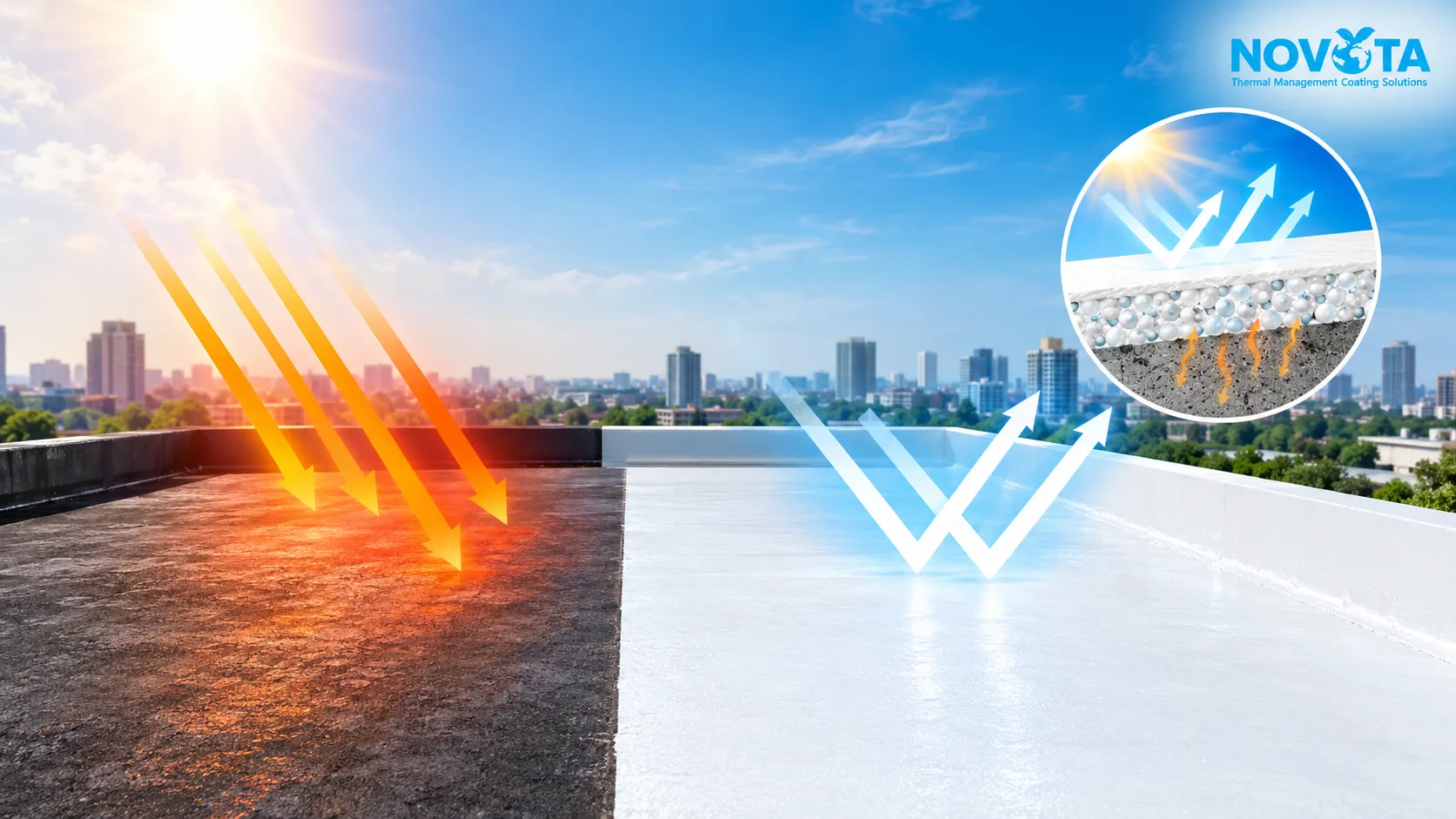
Heat reflective paint, also known as solar reflective paint or cool roof coating, is a specialized coating engineered to reflect a significant portion of solar radiation away from a surface rather than allowing it to be absorbed. Unlike conventional paints that may absorb 80-90% of incident solar energy, high-performance heat reflective coatings can reflect up to 90% of solar radiation, dramatically reducing surface temperatures and the amount of heat transferred into the underlying structure.
The concept might seem straightforward, but the engineering behind effective heat reflective paint is remarkably sophisticated. These coatings work through a combination of high solar reflectance (the ability to reflect sunlight) and high thermal emissivity (the ability to release absorbed heat as thermal radiation). This dual-action mechanism is what differentiates premium heat reflective coatings from ordinary white paint.
The Science of Solar Reflectance
Solar reflectance, measured on a scale from 0 to 1 (or 0% to 100%), indicates the fraction of solar energy that is reflected by a surface. A surface with a solar reflectance of 0.85 reflects 85% of solar energy and absorbs only 15%. The Solar Reflectance Index (SRI) is a related metric that incorporates both reflectance and emissivity to provide a comprehensive measure of a material’s ability to reject solar heat.
When sunlight strikes a roof or exterior surface coated with conventional dark-colored paint, the majority of that energy is absorbed, converting into heat that raises the surface temperature—often to 70-80°C or higher during peak summer conditions in India. This absorbed heat then conducts through the roof structure, radiates into the interior space, and creates an enormous cooling load that air conditioning systems must work against.
Heat reflective paint changes this equation fundamentally. By reflecting the majority of solar radiation before it can be converted to heat, these coatings can reduce peak surface temperatures by 20-30°C compared to conventional coatings. This temperature reduction translates directly into reduced heat gain, lower air conditioning costs, improved indoor comfort, and extended roof life.
The Role of Thermal Emissivity
While solar reflectance is crucial, thermal emissivity is equally important for optimal performance. Emissivity refers to a material’s ability to release absorbed heat as infrared thermal radiation. Even highly reflective surfaces absorb some solar energy, and materials with high emissivity can efficiently dissipate this absorbed heat rather than retaining it.
At Novota, our SunSheetal formulation achieves thermal emissivity values exceeding 0.90, meaning that more than 90% of absorbed heat is re-radiated away from the surface rather than conducted into the building structure. This high emissivity is achieved through carefully engineered ceramic microspheres and specialized pigments that optimize both reflective and emissive properties.
The combination of high reflectance and high emissivity creates a powerful thermal management system. During daylight hours, the coating reflects the majority of solar radiation. The small fraction that is absorbed is quickly re-radiated, preventing heat buildup. This explains why heat reflective coatings remain surprisingly cool to the touch even under direct sunlight, while conventional roof surfaces become uncomfortably hot.
How Heat Reflective Paint Actually Works: The Technology Breakdown
To truly appreciate the performance of advanced heat reflective coatings, we need to examine the specific technological components and mechanisms that make them effective.
Advanced Pigment Technology
The pigments used in heat reflective paints are fundamentally different from those in conventional coatings. Standard colored pigments are selected primarily for their visual appearance, with thermal performance as an afterthought. In contrast, heat reflective coatings utilize specially engineered pigments selected for their ability to reflect solar radiation across the entire solar spectrum—particularly in the near-infrared region where much of the sun’s heating energy resides.
Our SunSheetal formulation incorporates titanium dioxide-based pigments with optimized particle size distribution. Titanium dioxide is particularly effective because it exhibits high reflectance across both visible and near-infrared wavelengths. The particle size is carefully controlled because reflectance is maximized when particle dimensions are approximately half the wavelength of the light being reflected.
Additionally, we incorporate specialized cool-color pigments that maintain aesthetic appeal while maximizing infrared reflectance. These advanced pigments allow us to offer heat reflective coatings in various colors, not just white, while still achieving superior thermal performance. This is particularly important for architectural applications where design aesthetics cannot be compromised.
Ceramic Microsphere Technology
A defining feature of premium heat reflective coatings is the incorporation of hollow ceramic microspheres. These microscopic, hollow glass or ceramic spheres serve multiple functions that enhance thermal performance:
Reflective Interfaces: Each microsphere creates multiple air-material interfaces that scatter and reflect incident radiation. With millions of microspheres distributed throughout the coating, this creates an extensive network of reflective surfaces that collectively enhance overall solar reflectance.
Thermal Insulation: The air trapped within hollow microspheres provides additional insulation, creating microscopic thermal barriers that reduce conductive heat transfer through the coating. This is why heat reflective paints often feel noticeably cooler to the touch than conventional coatings—the ceramic microspheres interrupt the thermal pathway.
Enhanced Durability: Ceramic microspheres are exceptionally stable materials that resist UV degradation, maintain their reflective properties over time, and contribute to the mechanical strength and weather resistance of the coating.
At Novota, we’ve optimized the size distribution and concentration of ceramic microspheres in SunSheetal to maximize thermal performance while maintaining excellent application characteristics and long-term durability.
High-Performance Binder Systems
The binder or resin system that holds the pigments and microspheres together is crucial for both performance and longevity. Heat reflective coatings must withstand intense UV exposure, thermal cycling, moisture, and environmental pollutants while maintaining their reflective properties for years or decades.
SunSheetal utilizes advanced acrylic polymer binders specifically formulated for Indian climatic conditions. These binders provide:
- UV Stability: Resistance to degradation from intense solar ultraviolet radiation
- Flexibility: Ability to expand and contract with substrate movement without cracking
- Water Resistance: Protection against monsoon rains and humidity
- Dirt Resistance: Self-cleaning properties that help maintain reflectance over time
- Adhesion: Strong bonding to various substrates including concrete, metal, and existing coatings
The binder chemistry is engineered to remain stable at the elevated temperatures that roof surfaces experience, preventing degradation that would compromise reflective performance over time.

Heat Reflective Paint vs Heat Resistant Paint: Understanding the Difference
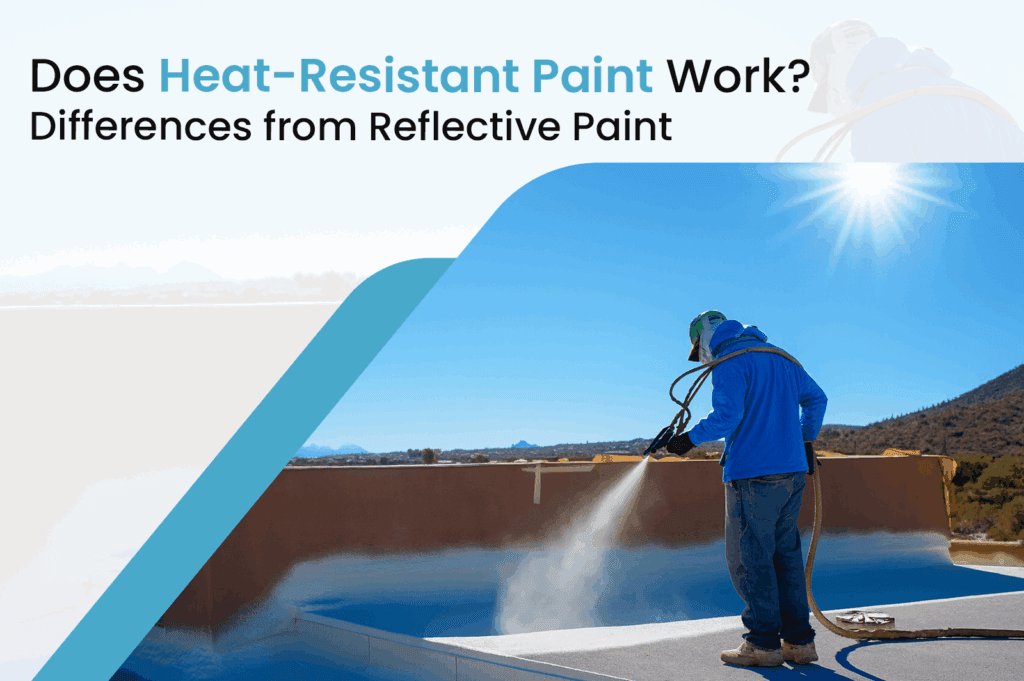
One of the most common questions we encounter at Novota is the distinction between heat reflective paint and heat resistant paint. While these terms are sometimes used interchangeably, they refer to fundamentally different technologies designed for different applications.
Heat Reflective Paint: Preventing Heat Absorption
Heat reflective paint, as we’ve discussed, is designed to reflect solar radiation and prevent heat absorption. The primary goal is to keep surfaces cool by reflecting sunlight before it can be converted to heat. These coatings are ideal for:
- Rooftops and terraces exposed to direct sunlight
- External walls of buildings
- Metal roofing and cladding
- Storage tanks and silos
- Any application where reducing solar heat gain is the priority
Performance is measured by solar reflectance, thermal emissivity, and the resulting surface temperature reduction. Heat reflective coatings typically reduce surface temperatures by 20-30°C compared to conventional coatings.
Heat Resistant Paint: Withstanding High Temperatures
Heat resistant paint, in contrast, is formulated to maintain its integrity and protective properties when exposed to elevated temperatures from sources other than solar radiation. These coatings are engineered to withstand continuous or intermittent exposure to high temperatures without degrading, discoloring, or losing adhesion.
Heat resistant coatings are essential for:
- Industrial furnaces and kilns
- Exhaust systems and chimneys
- Boilers and heat exchangers
- Engine components
- Manufacturing equipment operating at high temperatures
Performance is measured by the maximum temperature the coating can withstand while maintaining its protective and aesthetic properties. Heat resistant coatings may be rated for continuous exposure to temperatures ranging from 200°C to over 600°C, depending on the formulation.
Choosing the Right Solution
The distinction is important because selecting the wrong type of coating can result in poor performance or premature failure. If your goal is to reduce the temperature of a roof exposed to sunlight, heat reflective paint is the appropriate choice. If you need to protect equipment that operates at high temperatures, heat resistant paint is required.
At Novota, we offer both categories of solutions. Our SunSheetal product line addresses solar heat management, while our specialized high-temperature coatings serve industrial applications. Understanding your specific thermal challenge is the first step toward selecting the optimal coating solution.
The Performance Benefits: What Heat Reflective Paint Can Actually Achieve
The theoretical advantages of heat reflective paint are compelling, but what matters most is real-world performance. Based on extensive field testing and thousands of installations across India, we can quantify the actual benefits that properly selected and applied heat reflective coatings deliver.
Temperature Reduction
Surface temperature reduction is the most immediate and measurable benefit. In controlled tests conducted on concrete roofs in Mumbai during peak summer conditions, we documented the following results:
- Uncoated concrete roof: Peak surface temperature of 68°C
- Conventional white paint: Peak surface temperature of 58°C
- Novota SunSheetal: Peak surface temperature of 42°C
This represents a reduction of 26°C compared to the uncoated surface and 16°C compared to conventional white paint. The interior ceiling temperature reduction was proportionally significant, with indoor temperatures 4-7°C lower in spaces protected by SunSheetal.
On metal roofing, the results are even more dramatic. Uncoated or dark-colored metal roofs can reach surface temperatures exceeding 80°C. After application of heat reflective coating, we’ve measured peak temperatures in the range of 45-50°C—a reduction of more than 30°C.
Energy Savings
Temperature reduction translates directly into reduced air conditioning costs. Multiple case studies at commercial and industrial facilities have documented cooling energy savings of 15-30% after application of heat reflective roof coatings.
The exact savings depend on several factors:
- Building type and insulation levels: Buildings with minimal roof insulation see greater savings
- Air conditioning system efficiency: Older, less efficient systems show proportionally greater improvement
- Occupancy patterns: Facilities with high cooling loads during daylight hours benefit most
- Climate zone: Regions with intense solar radiation and long cooling seasons maximize savings
Even conservative estimates show that properly applied heat reflective coatings typically achieve payback periods of 2-4 years through energy savings alone, making them one of the most cost-effective energy efficiency investments available.
Extended Roof Life
Beyond energy savings, heat reflective coatings significantly extend roof service life by reducing thermal stress and UV degradation. Roofing materials expand when heated and contract when cooled. This daily thermal cycling creates mechanical stress that, over years, contributes to cracking, delamination, and other forms of deterioration.
By maintaining lower surface temperatures, heat reflective coatings reduce thermal cycling stress. Additionally, the UV-resistant formulation protects underlying roofing materials from photodegradation. We’ve observed that roofs protected with quality heat reflective coatings often last 5-10 years longer than unprotected roofs, deferring costly roof replacement expenses.
Improved Comfort and Indoor Air Quality
The impact on occupant comfort extends beyond temperature reduction. Lower ceiling temperatures reduce radiant heat transfer to building occupants, improving thermal comfort even when air temperature remains the same. This is particularly noticeable in warehouses, factories, and other facilities with high ceilings where air conditioning is impractical or impossible.
Furthermore, by reducing cooling loads, heat reflective coatings allow HVAC systems to operate more efficiently with better humidity control and air circulation, contributing to improved indoor air quality.
Applications: Where Heat Reflective Paint Makes the Biggest Difference
Heat reflective coatings deliver value across an extraordinarily wide range of applications. Understanding where these coatings provide maximum benefit helps in prioritizing investment and setting appropriate performance expectations.
Residential Roofing
For homeowners, rooftop terraces and upper-floor rooms that become uncomfortably hot during summer are ideal candidates for heat reflective coatings. SunSheetal has been successfully applied to:
- Concrete terrace roofs
- Asbestos cement sheeting
- Metal roofing
- Tile roofs (with appropriate primers)
Homeowners consistently report reduced indoor temperatures, lower electricity bills, and improved comfort in previously uninhabitable attic or top-floor spaces.
Commercial Buildings
Office buildings, shopping centers, hotels, and other commercial facilities with large roof areas experience substantial benefits. The combination of reduced cooling costs, improved occupant comfort, and extended roof life creates a compelling return on investment. Additionally, heat reflective coatings contribute to green building certification programs such as LEED and GRIHA, supporting corporate sustainability objectives.
Industrial Facilities
Warehouses, manufacturing plants, and distribution centers with large metal or concrete roofs are among the highest-value applications for heat reflective coatings. Many industrial facilities operate with minimal air conditioning, relying instead on natural ventilation or spot cooling. In these environments, reducing radiant heat from the roof can transform working conditions, improving productivity and worker safety.
For temperature-controlled warehouses storing pharmaceuticals, food products, or other temperature-sensitive materials, heat reflective coatings reduce the thermal load on refrigeration systems, lowering operating costs and improving reliability.
Specialty Applications
Beyond conventional roofing, heat reflective coatings serve numerous specialty applications:
- Storage tanks: Reducing product temperature in petroleum, chemical, and water storage tanks
- Transport containers: Protecting temperature-sensitive cargo during transport and storage
- Agricultural structures: Improving conditions in greenhouses, poultry houses, and livestock facilities
- Temporary structures: Controlling heat in prefabricated buildings and construction site offices
At Novota, we work closely with clients to understand their specific thermal challenges and customize our coating recommendations and application protocols accordingly.
Selection Criteria: Choosing the Right Heat Reflective Paint
Not all heat reflective paints are created equal. Performance varies dramatically based on formulation quality, application thickness, surface preparation, and environmental conditions. Here’s what you need to know to make an informed selection.
Performance Specifications
When evaluating heat reflective coatings, insist on documented performance data for:
Solar Reflectance: Look for values of 0.80 or higher for white coatings. Novota SunSheetal achieves solar reflectance values exceeding 0.85.
Thermal Emissivity: Values should exceed 0.85 for optimal heat dissipation. SunSheetal achieves emissivity above 0.90.
Solar Reflectance Index (SRI): This composite metric should exceed 100 for premium white coatings. SunSheetal achieves SRI values approaching 120.
Durability and Longevity
Performance means nothing if the coating degrades rapidly. Evaluate:
- Accelerated weathering data: Results from QUV or xenon arc testing demonstrating retained reflectance after extended UV exposure
- Warranty terms: Reputable manufacturers stand behind their products with meaningful performance warranties
- Field performance history: Case studies and references from installations in similar climatic conditions
Novota provides comprehensive technical data sheets and performance warranties backed by decades of field experience across India’s diverse climatic zones.
Application Requirements
Consider practical application factors:
- Surface compatibility: Ensure the coating is suitable for your substrate (concrete, metal, asbestos, existing coatings, etc.)
- Surface preparation requirements: Understand what preparation is necessary for optimal adhesion and performance
- Application method: Determine whether spray, roller, or brush application is most appropriate
- Dry film thickness: Sufficient thickness (typically 250-400 microns for SunSheetal) is essential for achieving specified performance
- Curing requirements: Factor in drying time and curing conditions for project scheduling
Cost Considerations
While initial cost is important, focus on lifecycle cost rather than simply the lowest price per liter. A premium coating that delivers superior performance and durability will almost always provide better value than a budget product that degrades quickly or fails to deliver promised performance.
Consider the total investment including:
- Surface preparation costs
- Labor and application costs
- Performance characteristics (reflectance, durability)
- Expected service life
- Warranty coverage
- Energy savings and other operational benefits
Application Best Practices: Achieving Optimal Performance
Even the highest-quality heat reflective paint will underperform if not properly applied. At Novota, we’ve developed comprehensive application protocols refined through thousands of installations. Here are the critical factors for success.
Surface Preparation: The Foundation of Performance
Surface preparation is arguably more important than the coating itself. Proper preparation ensures:
- Adhesion: The coating bonds securely to the substrate
- Uniform coverage: Even application without thin spots that compromise performance
- Longevity: Maximum service life without premature delamination or failure
For concrete and masonry surfaces:
- Remove all loose material, dirt, grease, and contaminants
- Repair cracks, spalls, and damaged areas with appropriate patching compounds
- Ensure the surface is completely dry (moisture content below 8%)
- Apply suitable primer if required (particularly on porous or previously uncoated surfaces)
For metal surfaces:
- Remove rust, mill scale, and previous coatings as appropriate
- Degrease thoroughly to remove oils and contaminants
- Apply anti-corrosive primer compatible with the topcoat system
- Ensure complete dryness before topcoat application
Application Technique
SunSheetal can be applied by brush, roller, or airless spray. Each method has advantages depending on surface characteristics and project scale:
Brush application: Provides excellent penetration and is ideal for smaller areas or irregular surfaces
Roller application: Efficient for large, flat surfaces with good film build
Airless spray: Most efficient for large projects, providing uniform coverage and optimal productivity
Regardless of method, maintain proper wet film thickness to achieve specified dry film thickness after curing. For SunSheetal, we typically recommend two coats totaling 300-400 microns dry film thickness for optimal thermal performance.
Environmental Conditions
Application conditions significantly impact coating performance:
- Temperature: Apply when surface and ambient temperature are between 10°C and 35°C
- Humidity: Relative humidity should be below 85% to ensure proper curing
- Moisture: Do not apply to damp surfaces or when rain is imminent
- Wind: Avoid application in strong winds that can cause uneven coverage or contamination
Allow adequate curing time between coats and before exposing the coating to foot traffic, rain, or other stresses. While SunSheetal is typically touch-dry within 2-3 hours, full cure requires 7 days under normal conditions.

The Future of Heat Reflective Technology: Innovation at Novota
At Novota Thermotech, we’re constantly pushing the boundaries of what’s possible in thermal coating technology. Our R&D initiatives are focused on several exciting areas:
Advanced Color Options
While white coatings achieve maximum solar reflectance, aesthetic considerations often require colored finishes. We’re developing next-generation cool-color pigments that maintain high near-infrared reflectance while providing a wide palette of attractive colors. This enables architects and building owners to specify heat reflective coatings without compromising design intent.
Self-Cleaning Surfaces
Dirt accumulation reduces reflective performance over time. We’re incorporating photocatalytic and hydrophilic technologies that enable self-cleaning properties, where rain naturally removes dirt and pollutants, maintaining peak reflectance throughout the coating’s service life.
Enhanced Durability Formulations
While SunSheetal already provides excellent durability, we’re working on even more robust formulations for extreme environments—coastal areas with salt spray, industrial zones with chemical exposure, and regions with intense UV and thermal stress.
Integrated Functionality
Future heat reflective coatings will incorporate additional functional properties such as antimicrobial surfaces, air-purifying photocatalytic effects, and embedded sensors for smart building applications.
Making the Decision: Is Heat Reflective Paint Right for You?
Heat reflective paint delivers measurable, significant benefits for the vast majority of buildings in India’s climate. The combination of energy savings, improved comfort, extended roof life, and environmental benefits creates compelling value. However, the magnitude of benefits depends on your specific situation.
You’ll see maximum benefit if:
- Your building has a large roof area relative to conditioned space
- Roof insulation is minimal or absent
- Cooling loads are significant during daylight hours
- The roof surface is exposed to direct sunlight for extended periods
- You’re in a hot climate with high solar radiation
Benefits will be more modest if:
- The building already has substantial roof insulation
- Cooling loads are primarily from internal sources rather than solar gain
- The roof is shaded by trees or adjacent structures
- You’re in a temperate climate with moderate solar exposure
At Novota, we provide honest, technically grounded guidance to help you understand what heat reflective coatings can realistically achieve for your specific application. We believe in building long-term relationships based on delivering real value, not overpromising performance.
Conclusion: Investing in Intelligent Thermal Management
As energy costs continue to rise and climate change intensifies, intelligent thermal management isn’t just an option—it’s a necessity. Heat reflective paint represents one of the most cost-effective, proven technologies available for reducing cooling loads, improving comfort, and creating more sustainable buildings.
With proper product selection, surface preparation, and application, heat reflective coatings from Novota deliver:
- Surface temperature reductions of 20-30°C
- Energy savings of 15-30% on cooling costs
- Extended roof service life
- Improved indoor comfort
- Reduced environmental impact
- Attractive return on investment with typical payback periods of 2-4 years
At Novota Thermotech Pvt Ltd, we’ve dedicated over two decades to perfecting thermal coating solutions for India’s unique challenges. Our SunSheetal product represents the culmination of extensive research, rigorous testing, and continuous refinement based on real-world performance.
Whether you’re a homeowner looking to cool your terrace, a facility manager seeking to reduce operating costs, or an architect specifying coatings for a new project, we invite you to experience the Novota difference. Our technical team is ready to analyze your specific requirements and recommend the optimal thermal coating solution.
The science is proven. The technology is mature. The benefits are real and measurable. The only question is: when will you join the thousands of satisfied clients who’ve already discovered how advanced heat reflective coatings can transform their buildings?
Ready to reduce your building’s heat load and cooling costs? Contact Novota Thermotech today for a technical consultation and discover how our advanced thermal coating solutions can deliver measurable performance improvements for your specific application.
About Novota Thermotech Pvt Ltd
Based in Mumbai, India, Novota Thermotech Pvt Ltd is a leading innovator in advanced thermal coating solutions. With comprehensive expertise in heat reflective coatings, high-temperature resistant coatings, and thermal management technologies, we serve residential, commercial, and industrial clients across India and internationally. Our commitment to scientific rigor, product quality, and customer success has made us a trusted partner for thermal challenges ranging from roof cooling to industrial furnace efficiency. Learn more at novota.in.
1. What is heat reflective paint?
Heat reflective paint is a specialized coating designed to reflect solar radiation and reduce heat absorption by roofs and exterior surfaces. Unlike conventional paint, it combines high solar reflectance and thermal emissivity to keep buildings cooler, improve indoor comfort and reduce air conditioning costs.
2. How does heat reflective paint work?
Heat reflective paint works by reflecting a significant portion of incoming sunlight, including near-infrared radiation, before it becomes heat. Its high thermal emissivity also helps the coated surface release absorbed heat. Advanced coatings such as Novota SunSheetal use specialized pigments, ceramic microspheres and high-performance binders to improve thermal performance.
3. Does heat reflective paint really reduce roof temperature?
Yes. High-performance heat reflective coatings can significantly reduce roof surface temperatures under direct sunlight. Novota reports surface temperature reductions of 20–30°C in suitable conditions. Actual performance depends on roof material, sunlight exposure, ambient temperature, coating quality and application.
4. What is the difference between heat reflective paint and ordinary white paint?
Ordinary white paint reflects visible sunlight but is not necessarily optimized for infrared reflectance, thermal emissivity or long-term thermal performance. Advanced heat reflective paint uses specially engineered pigments and other materials to improve solar heat rejection and maintain its performance under demanding environmental conditions.
5. What is the difference between heat reflective paint and heat resistant paint?
Heat reflective paint reduces solar heat absorption and is commonly used on roofs, terraces and exterior walls. Heat resistant paint is designed to withstand elevated operating temperatures without degrading. It is used on industrial furnaces, boilers, chimneys, exhaust systems and other high-temperature equipment.
Performance and Energy Savings
6. How much temperature reduction can heat reflective paint provide?
According to Novota’s reported field observations, properly applied heat reflective coatings can reduce roof surface temperatures by approximately 20–30°C compared with untreated or conventional surfaces. The reduction varies according to roof material, weather conditions, existing insulation and solar exposure.
7. Can heat reflective paint reduce electricity bills?
Yes. By reducing solar heat gain through roofs and exterior surfaces, heat reflective paint can lower the cooling demand on air conditioning systems. Novota reports cooling energy savings of approximately 15–30% in certain commercial and industrial applications. Actual savings depend on building design, insulation, climate and HVAC efficiency.
8. Does heat reflective paint keep rooms cooler without air conditioning?
Heat reflective paint can improve indoor thermal comfort even in buildings without air conditioning. By reducing roof temperatures, it decreases heat transfer into rooms below. This is particularly useful for top-floor apartments, warehouses, factories and buildings with limited roof insulation.
9. What is the Solar Reflectance Index (SRI) of heat reflective paint?
The Solar Reflectance Index is a performance indicator that combines solar reflectance and thermal emissivity to describe how effectively a surface rejects solar heat. Higher SRI values generally indicate better heat-rejection performance. When comparing coatings, check independently tested SRI values alongside solar reflectance and emissivity.
10. How long does heat reflective paint last?
The service life of heat reflective paint depends on its formulation, substrate, surface preparation, environmental exposure and maintenance. High-quality coatings are designed to resist UV radiation, moisture and thermal cycling. Review the manufacturer’s technical data sheet, durability test results and warranty before selecting a product.
Applications and Suitability
11. Which heat reflective paint is suitable for concrete roofs in India?
For concrete roofs in India’s hot climate, look for a coating with high solar reflectance, high thermal emissivity, UV resistance and compatibility with concrete substrates. Novota SunSheetal is designed for solar heat management on roofs and other exterior surfaces. Correct preparation and application are essential to achieving its intended performance.
12. Can heat reflective paint be applied to metal roofs?
Yes. Heat reflective paint can be applied to compatible metal roofing to reduce solar heat absorption. Before application, the surface must be cleaned, rust removed and a suitable anti-corrosive primer applied where required. Metal-roof applications can be particularly useful for industrial sheds, factories and warehouses.
13. Is heat reflective paint suitable for exterior walls?
Yes. Heat reflective coatings can be used on suitable exterior walls to reduce solar heat absorption, particularly on walls exposed to intense afternoon sunlight. Their effectiveness depends on wall orientation, surface material, existing insulation and the amount of direct solar exposure.
14. Can heat reflective paint be used on industrial warehouses and factories?
Yes. Industrial warehouses, manufacturing facilities and distribution centers are important applications for heat reflective coatings. Large exposed metal or concrete roofs can absorb substantial solar heat. Reflective coatings can reduce roof temperatures, improve working conditions and lower cooling loads in temperature-controlled facilities.
15. Can heat reflective paint be applied over existing roof paint?
Heat reflective paint may be applied over compatible existing coatings if they are firmly adhered and in suitable condition. Loose paint, dirt, grease and damaged areas must be removed or repaired. A compatible primer may be necessary to ensure adhesion and long-term coating performance.
Technology and Application
16. What are ceramic microspheres in heat reflective paint?
Ceramic microspheres are microscopic hollow particles incorporated into certain advanced thermal coatings. They create multiple material interfaces that scatter radiation and can contribute to the coating’s thermal properties. Their effectiveness depends on particle characteristics, concentration and the overall coating formulation.
17. What is thermal emissivity in heat reflective coatings?
Thermal emissivity measures how effectively a surface emits thermal radiation. It is expressed on a scale from 0 to 1. A coating with high thermal emissivity can efficiently release absorbed heat through thermal radiation, helping reduce surface temperature when combined with high solar reflectance.
18. How many coats of heat reflective paint are required?
The number of coats depends on the product, substrate and required film thickness. The supplied article describes a typical two-coat application for Novota SunSheetal. Follow the current product technical data sheet for the specified coverage, thickness, drying interval and curing requirements.
19. How should a roof be prepared before applying heat reflective paint?
Roof preparation typically involves removing dust, grease, loose coatings and other contaminants. Cracks and damaged areas should be repaired, and the substrate must be sufficiently dry. Depending on the surface, a compatible primer may be required. Proper preparation improves adhesion, uniform coverage and coating durability.
20. Can heat reflective paint be applied during the monsoon?
Heat reflective paint should not be applied to damp surfaces or when rain is imminent. Excessive humidity and moisture can interfere with adhesion and curing. Plan application during suitable dry weather and follow the manufacturer’s temperature, humidity and curing recommendations.
Cost, Sustainability and SunSheetal
21. Is heat reflective paint cost-effective for residential and commercial buildings?
Heat reflective paint can be a cost-effective thermal management solution for buildings with substantial solar exposure and cooling requirements. Its financial benefits depend on installation costs, achievable energy savings, building insulation, local climate and expected coating life. A building-specific assessment helps estimate the potential return on investment.
22. Does heat reflective paint help achieve green building certification?
Heat reflective coatings with suitable tested performance may contribute to applicable cool-roof and energy-efficiency requirements in green building rating systems such as LEED and GRIHA. Eligibility depends on the specific certification scheme, project requirements and independently documented coating performance.
23. What makes Novota SunSheetal different from conventional roof paint?
Novota SunSheetal is a specialized heat reflective coating developed for solar heat management. Its formulation incorporates engineered reflective pigments, ceramic microspheres and high-performance binders. It is designed to reduce solar heat absorption, support indoor thermal comfort and help lower cooling loads in suitable residential, commercial and industrial applications.
24. Where can Novota SunSheetal heat reflective paint be used?
Novota SunSheetal is intended for compatible roofs and exterior surfaces, including concrete terraces, metal roofing and industrial buildings. Suitable applications can include residential properties, commercial facilities, warehouses and manufacturing plants. Surface compatibility and preparation requirements should be confirmed before installation.
25. Where can I get technical guidance for heat reflective paint in India?
Novota Thermotech Pvt Ltd provides technical guidance for selecting heat reflective coatings for residential, commercial and industrial applications. Its team can assess the substrate, solar exposure and thermal management requirements to recommend an appropriate coating and application method. Visit novota.in for further information.
SEO implementation: Use these FAQs under relevant article sections or in a dedicated FAQ section. Add valid FAQPage structured data where appropriate, although Google generally limits FAQ rich results to eligible authoritative government and health websites. Before publication, verify product-specific numerical claims against Novota’s latest technical data sheet, particularly reflectance, emissivity, film thickness and curing time, as the supplied article contains differing specifications.
Subscribe our Channel for regular updates.
- How Novota’s Functional Coatings are Revolutionising Furnace Efficiency
- What is a Thermal Conductive Coating? Industrial Applications & Properties
- Why Every Energy Generator Industry Should Consider emiSEAL
- Understanding Heat Reflective Coatings: Benefits, Uses & How They Work
- Does Solar Reflective Paint Work? Here’s What Science Says
- Emissivity Explained: The Key to Effective Thermal Management in Coatings
- Why Tempseal is Essential for Iron and Steel Processing
- How Novota’s Advanced Coatings Are Shaping the Future of the Automotive Industry
- Simplifying the Science Behind High Emissivity Coatings
- Tempseal: A Key to Safety and Efficiency in Petrochemical Operations
- The Importance of Surface Preparation Before Applying Industrial Coatings
- How Heat Reflective Coatings Reduce Energy Expenses and Improve Employee Well-Being
- Heat Dissipation Coating to Reduce the Air Pressure in Automobile Tires
- How can heat-reflective paint improve energy efficiency in buildings?
- A Guide for Choosing the Right Industrial Coating for Heat Management and Performance
- Heat dissipation coating to effectively manage thermal energy for a global leader in the wire and cable industry
- The Future of Industrial Coatings: Trends and Innovations to Watch
- The Economic Benefits of Investing in High-Performance Industrial Coatings
- Top 7 Benefits of Using Heat Reflective Paint
- Thermal Emissivity Paint