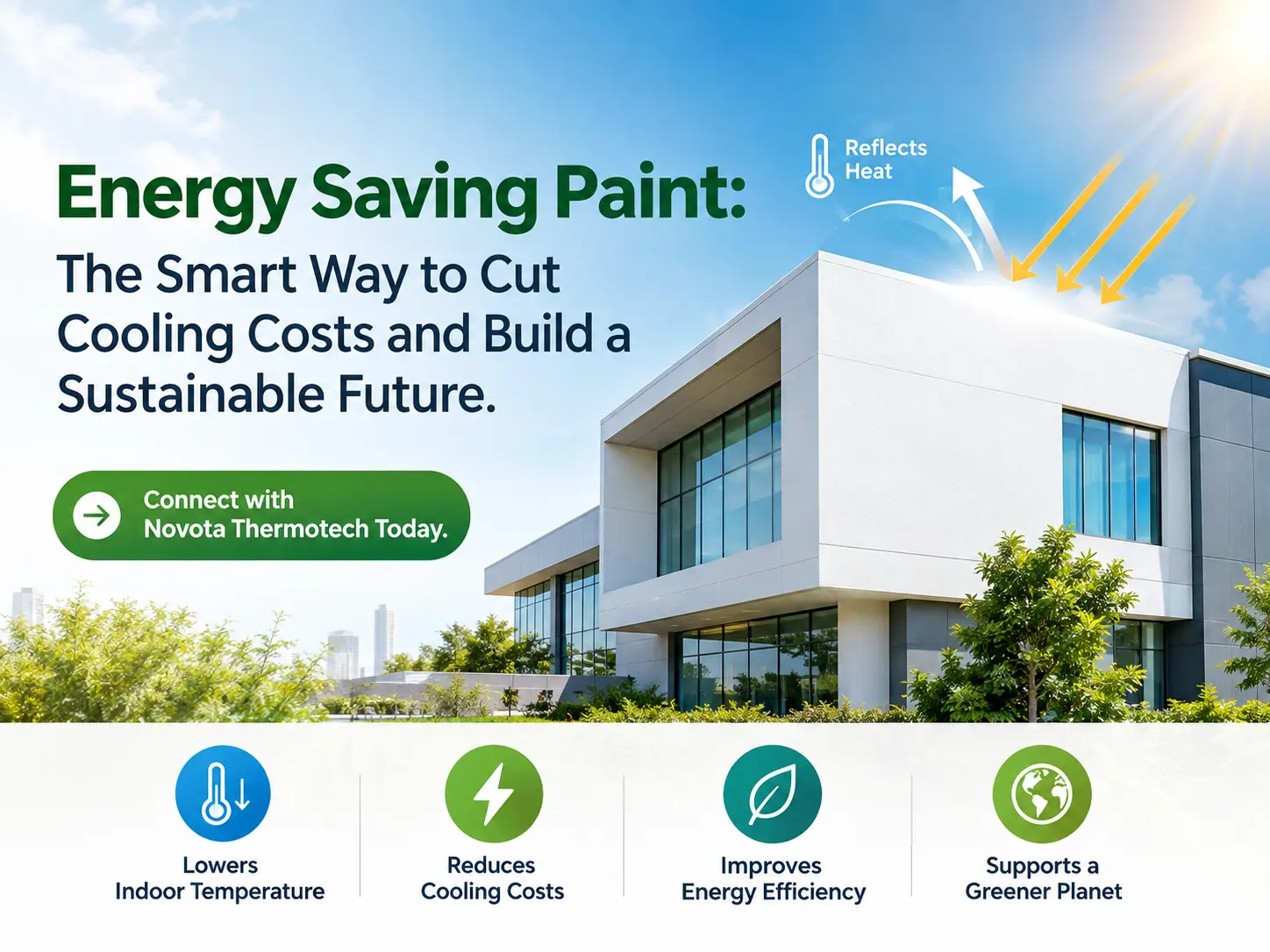


Learn how solar reflective paint works to reduce heat, lower indoor temperature, and improve energy efficiency using SRI and thermal emittance.
Short answer: Solar reflective paint for the roof, also known as heat reflective coating, is made with special pigments that reflect more sunlight. So, yes, they do work in preventing unnecessary heat buildup.
But how does it work exactly? This blog breaks down the science behind solar reflective paint. By the end of this blog, you will be able to decode the product label as well. Let us start by understanding the basics: how the temperatures of your roof and walls affect the indoor temperature?
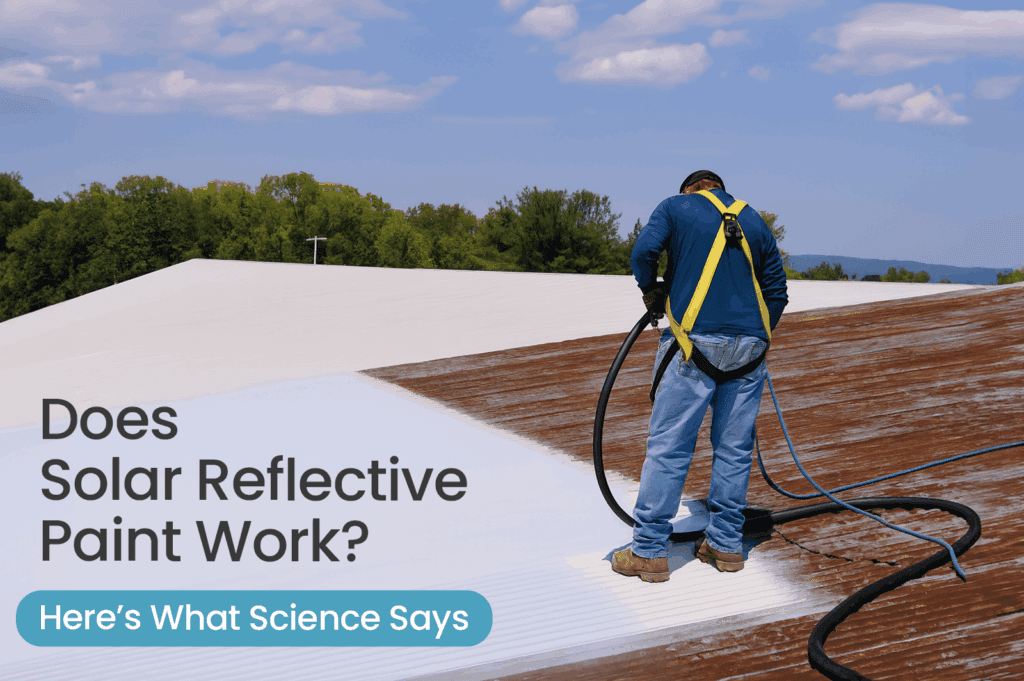
Thermal reflective coating for roof
How does roof temperature affect the indoor temperature?
- UV light
- Visible light
- Infrared light
These forms of light are absorbed by the surface, causing it to heat up. When the roof becomes hotter than the indoor air, heat starts to move inward. This happens because heat always flows from a warmer area to a cooler one, according to the laws of thermodynamics.
The amount of heat absorbed by the roof directly affects indoor temperature. And that heat absorption depends largely on the material and colour of the surface.
- Metal roofs heat up quickly due to their high thermal conductivity, but they also cool down rapidly after sunset.
- Concrete roofs absorb heat slowly but trap it for much longer. Even after sunset, they continue to radiate heat indoors, making nights warmer.
This is where solar reflective paint for the roof is useful.
What Is Solar Reflective Paint?
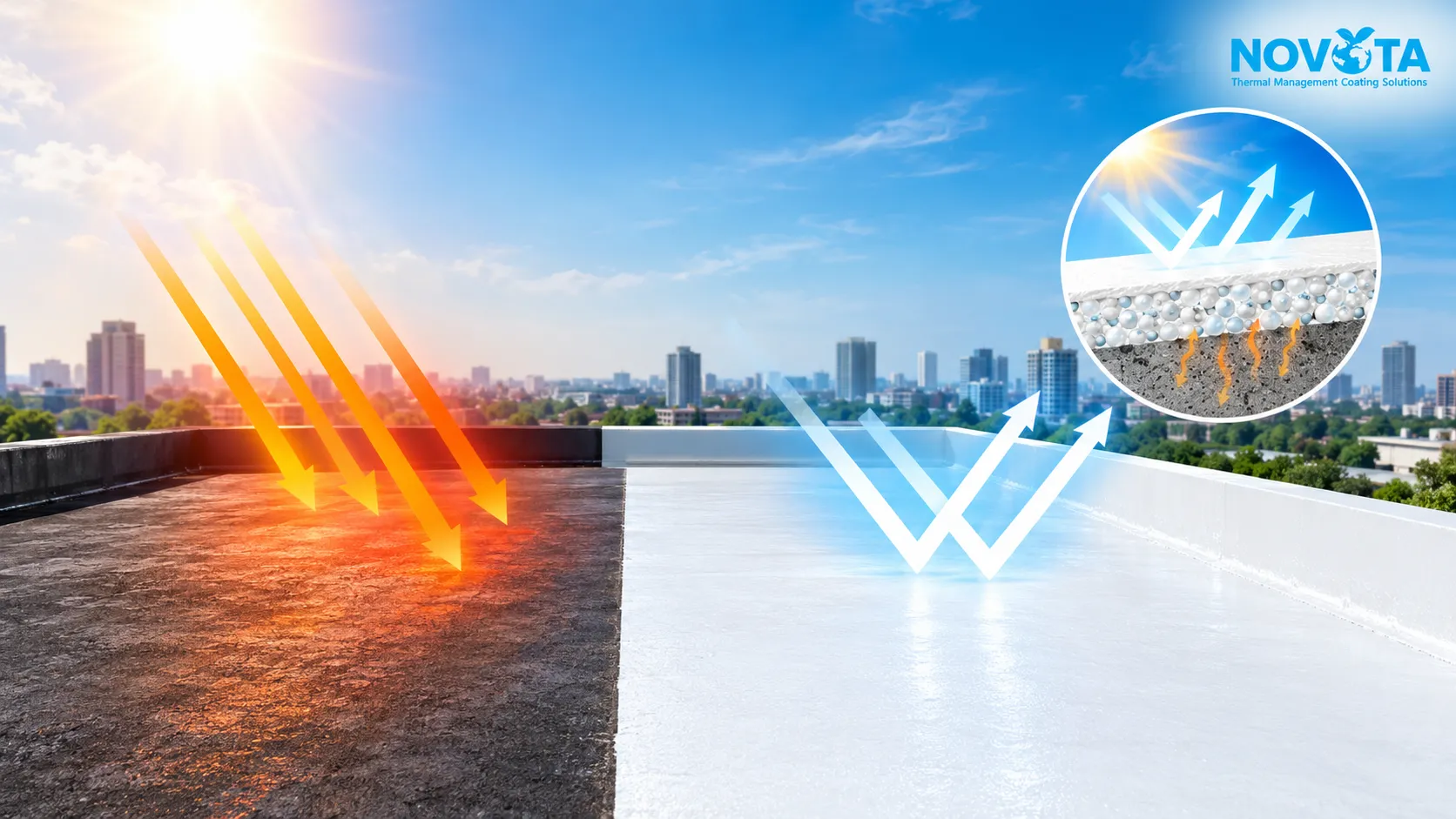
Solar reflective paint (also called cool roof paint or heat reflective coating) is made with special pigments that reflect sunlight, especially the infrared (IR) part of the spectrum, which carries most of the heat.
When applied to roofs, walls, or pavements, it tends to lower the surface temperature.
How does it work? The Science behind Solar Reflective Paint
Solar reflective paint is designed to reduce this heat gain. How? It works based on two principles: Solar reflectance and thermal emittance. Let us understand each of these properties in detail.
✅ 1. Reduces Roof Surface Temperature
Reflective coatings can reduce surface temperature by 10°C to 25°C, depending on climate and substrate.
✅ 2. Lowers Indoor Temperature
According to U.S. Department of Energy research:
- Non-AC buildings can see indoor temperature reduction of 1.2°C to 3.3°C
✅ 3. Saves Energy and Reduces AC Bills
Lower heat gain means:
- Reduced cooling load
- Less strain on HVAC systems
- Lower electricity bills
In commercial buildings, energy savings can range between 10–30%.
✅ 4. Reduces Urban Heat Island (UHI) Effect
Cities are hotter due to heat-absorbing surfaces.
Cool roof coatings:
- Reflect more solar radiation
- Reduce ambient city temperature
- Improve environmental sustainability
✅ 5. Improves Occupant Comfort
Especially beneficial for:
- Warehouses
- Factories
- Industrial sheds
- Schools
- Non-AC buildings
Workers experience better thermal comfort and productivity.
✅ 6. Extends Roof Life
High temperatures cause:
- Thermal expansion and contraction
- Cracking
- Waterproofing damage
Solar reflective coatings reduce thermal stress, increasing roof lifespan.
✅ 7. Supports Green Building Certifications
Cool roof coatings contribute to:
- LEED Certification
- IGBC Ratings
- GRIHA Compliance
They help projects meet sustainability and energy-efficiency benchmarks.
Where Else Is Heat Reflective Coating Used?
Solar reflective coatings are not limited to roofs. They are also used on:
- Pavements
- Parking decks
- Vehicle rooftops
- HVAC systems
- Industrial equipment
- Solar panel support structures
Does Solar Reflective Paint Work in Indian Climate?
Yes — especially in tropical and high-temperature regions like India.
India experiences:
- High solar radiation
- Long summer seasons
- Intense rooftop heat buildup
Using high-SRI coatings significantly reduces cooling demand in residential, commercial, and industrial buildings.
Limitations You Should Know
For complete transparency:
- Performance depends on proper surface preparation.
- Dirty or dusty roofs reduce reflectivity.
- Periodic maintenance improves long-term performance.
- Not a replacement for insulation — but a strong complementary solution.
Heat Reflective Paint for a Greener Future
The future of industrial coatings is energy-efficient and sustainable.
High-albedo coatings:
- Improve building performance
- Reduce carbon footprint
- Support ESG goals
- Enhance solar panel efficiency
What is SRI, and what does it tell you about heat reflective coatings?
Two surfaces might appear identical from the outside, but behave differently in sunlight due to SRI. SRI is calculated using a formula defined by the ASTM E1980 standard. It uses a reference roof surface (black and white) to compare temperature rise. To understand in layman’s terms,
- How hot a surface gets
- How cool it will stay in sunlight.
This means that higher SRI equals cooler surfaces under the sun.
Architects, engineers, and even building owners select materials that can reduce heat buildup, especially on the roof and walls. But how does roof temperature affect the indoor temperature?
But does cool roof paint technology matter?
- Reduces energy consumption and AC bills: Lower surface temperature means less heat enters the building. So, your air conditioning system doesn’t have to work as hard to maintain an optimum temperature, and your electricity bill drops significantly. This makes your building more energy-efficient.
- Reduces Urban Heat Island (UHI) effect: It is observed that cities are hotter than nearby rural areas. These solar reflective paints for the roof act as a solar heat reduction coating, trapping less heat and hence making the cities cooler.
- More Comfort: Working in non-AC places, such as warehouses or sheds, can be exceedingly miserable. These coatings can drop the inside temperature and improve employee well-being. Research by the U.S. Department of Energy shows that non-air-conditioned residential buildings can lower maximum indoor temperatures by 1.2–3.3 °C with cool roofs.
- Improves Roof Life: A roof under heat stress often cracks earlier. The solar heat-reducing paints for the roof reduce the thermal stress, leading to fewer repairs and a longer lifespan.
- Complies with Green building codes: Cool roof paint technology also supports sustainability standards such as LEED and IGBC. Novota’s Sunsheetal, a high-albedo, heat-reflective paint, has facilitated a cooler environment for over 250 green building projects.
Read More: Top 7 benefits of Heat Reflective Paint
Did you know: Heat-reflective coating is not only used on roofs, but also on pavements, vehicle rooftops, engines, and HVAC systems
Heat reflective paint for a greener tomorrow
The future of industrial coatings is green. High-albedo, heat-reflective paint is not only a key enabler of green buildings, but it also enhances the efficiency of solar panels, supporting smarter and more sustainable energy generation.
Explore Novota’s Advanced Functional Coating Solutions
At Novota Thermotech, we specialize in performance-driven industrial and sustainable coating technologies. With over 16 years of expertise, we provide innovative thermal and functional coating solutions tailored for commercial, industrial, and green building projects.
If you’re exploring solar reflective coatings, you may also benefit from our other advanced technologies:
🔹 Our Core Products
- HeatXperse – High emissivity coating designed to improve heat dissipation in furnaces and industrial equipment.
- emiSEAL – Advanced emissivity-based coating that enhances energy efficiency in high-temperature applications.
- TempSeal – Thermal insulation coating engineered to minimize heat loss and improve system efficiency.
- SunSheetal – High-SRI solar reflective paint designed for roof temperature reduction and energy savings.
- NovoPlast – Specialized functional coating for industrial performance enhancement.
- Custom Coating – Tailored coating solutions developed to meet unique industry-specific challenges.
🔹 Our Core Technologies
Our solutions are built on scientifically developed coating technologies:
- High Emissivity Technology – Improves radiant heat transfer and furnace efficiency.
- Heat Reflective Technology – Reduces solar heat gain and enhances building energy performance.
- Heat Insulation Technology – Minimizes heat transfer and improves thermal management systems.
🔹 Learn More About Novota
- Explore our journey on the About Us page.
- Read industry insights in our Blogs section.
- Discover practical implementations in our Case Studies.
- Stay updated through our Newsletters.
- For direct assistance, visit our Contact Page.
📞 Get in Touch with Our Experts
If you’re looking to improve energy efficiency, reduce thermal stress, or implement sustainable coating solutions, our team is ready to help.
📧 Email: info@novota.in
📍 Address:
Novota Thermotech Pvt. Ltd,
103, Building No.2, New Rajashree Industrial Premises CHSL,
Opp. Hyde Park, Chitalsar-Manpada,
Thane 400610, Maharashtra, India
📞 Call us:
+91 8928770345
+91 9320047879
Conclusion
Heat reflective coatings work and support a sustainable, energy-efficient future. Whether you are building a new structure or upgrading an old one, applying these coatings is a simple step with long-term benefits: for your comfort, your wallet, and the planet.
At Novota Thermotech, we create Sunsheetal, a solar-reflective paint with the highest SRI of 108. Connect with Novota Thermotech to explore Sunsheetal for your commercial, industrial, or green building projects.
FAQs
Is heat-reflective paint the same as white paint?
Does cool roof coating work in humid or cloudy climates?
Cool-roof coating helps reduce surface temperatures in any weather conditions.
Can heat-reflective paint be applied to any roof?
Yes, it works on most roof materials, including concrete, metal, asbestos, and tiles. However, it is essential to prepare the surface properly before applying the paint. Read More:https://novota.in/importance-of-surface-preparation-for-industrial-coatings/
How Solar Reflective Paint Works: Science Explained
Solar reflective paint works by reducing heat absorption on building surfaces through advanced thermal science involving solar reflectance, infrared emissivity, and heat radiation control. In hot climates, roofs and exterior walls absorb a large amount of solar energy, leading to increased indoor temperatures and higher cooling loads. Solar reflective coatings are engineered to minimize this heat gain and improve overall energy efficiency.Understanding how solar reflective paint works requires a deeper look into the interaction between sunlight and surface materials. When solar radiation hits a surface, it is either reflected, absorbed, or transmitted. Traditional construction materials tend to absorb a significant portion of this energy, converting it into heat. This heat is then transferred indoors, increasing dependency on air conditioning systems.
Science Behind Solar Reflective Paint
The effectiveness of solar reflective coatings is based on three key parameters: solar reflectance, thermal emittance, and Solar Reflectance Index (SRI). These parameters determine how efficiently a surface can reflect solar radiation and release absorbed heat.
1. Solar Reflectance
Solar reflectance refers to the ability of a surface to reflect incoming solar radiation. It is expressed as a value between 0 and 1. A higher value indicates greater reflectivity. Solar reflective paint contains specialized pigments that reflect a large portion of sunlight, including visible, ultraviolet (UV), and near-infrared (IR) radiation.By reflecting more solar energy, the surface absorbs less heat, which directly reduces temperature rise.
2. Thermal Emittance
Thermal emittance is the ability of a material to release absorbed heat in the form of infrared radiation. Even highly reflective surfaces can absorb some amount of heat. High thermal emittance ensures that this absorbed heat is quickly released back into the environment instead of being retained.Solar reflective coatings are designed to have both high reflectance and high emittance, ensuring efficient heat management.
3. Solar Reflectance Index (SRI)
The Solar Reflectance Index (SRI) is a combined metric that measures a material’s ability to stay cool under sunlight. It takes into account both solar reflectance and thermal emittance.Materials with higher SRI values remain significantly cooler compared to conventional surfaces. This is why reflective coatings are widely used in cool roof technologies.
How Solar Reflective Paint Reduces Heat
The primary function of reflective paint is to minimize heat gain. When applied to roofs or walls, it forms a protective layer that reflects solar radiation and prevents heat buildup.This leads to:
- Lower surface temperature (up to 10–25°C reduction)Reduced indoor temperatureLower air conditioning loadImproved occupant comfort
Unlike conventional paints, which absorb heat and radiate it inward, solar reflective coatings act as a thermal barrier, improving building energy efficiency.
Role of Infrared Radiation in Heat Transfer
A significant portion of solar heat comes from infrared radiation. Traditional paints absorb this radiation, causing surfaces to heat up rapidly.Solar reflective coatings use advanced pigments that reflect near-infrared radiation, which is responsible for most heat buildup. By reflecting IR radiation, these coatings prevent excessive temperature rise even under direct sunlight.
Applications of Solar Reflective Coatings
Solar reflective coatings are widely used across residential, commercial, and industrial sectors.
- Roofs: Reduce heat gain in buildings and improve cooling efficiencyWalls: Minimize heat transfer into interiorsIndustrial sheds: Lower internal working temperatureWarehouses: Improve storage conditions
These coatings are particularly effective in regions with high solar exposure.
Energy Efficiency and Cost Savings
By reducing heat gain, solar reflective paint lowers the demand for air conditioning systems. This results in significant energy savings, especially in commercial and industrial buildings where cooling costs are high.Studies show that reflective coatings can reduce energy consumption by up to 15–30%, depending on building design and climate conditions.Lower energy usage also contributes to reduced carbon emissions, making these coatings an environmentally sustainable solution
Durability and Performance
Modern solar reflective coatings are engineered for long-term performance. They are resistant to UV degradation, weathering, and thermal cycling. High-quality coatings maintain their reflectivity over time, ensuring consistent performance.Proper surface preparation and application play a key role in maximizing coating lifespan and effectiveness.
Limitations and Considerations
While solar reflective coatings offer multiple benefits, their performance depends on factors such as surface condition, climate, and application quality. Dust accumulation and surface degradation can reduce reflectivity over time, requiring periodic maintenance.Additionally, reflective coatings are most effective on exposed surfaces like roofs, where direct sunlight exposure is maximum.
How solar reflective paint works
Solar reflective paint works by combining advanced material science with thermal engineering principles to reduce heat absorption and improve energy efficiency. By reflecting solar radiation and emitting absorbed heat, these coatings help maintain lower surface and indoor temperatures.As energy costs rise and sustainability becomes a priority, solar reflective coatings offer a practical and cost-effective solution for heat management. Whether for residential buildings or industrial facilities, they play a crucial role in improving thermal performance and reducing environmental impact.