


Discover heat resistant coating NOVO 800 flame-resistant and electrically non-conductive coating for mild steel components. Call +91 8928770345.
Built for Heat. Engineered to Adhere.
In such conditions, conventional paints and general-purpose protective coatings may not provide the functional properties required by the application.
The challenge is not simply to apply a coating that looks good or provides basic surface protection. It is to select a specialised coating that can withstand elevated temperatures, maintain adhesion and provide the required electrical characteristics.
This is where NOVO 800 by Novota Thermotech introduces a specialised coating solution.
NOVO 800 is a heat-resistant, flame-resistant and electrically non-conductive coating developed for mild steel components. Designed for applications requiring thermal resistance and electrical insulation characteristics, it offers a combination of three important functional properties in one coating system.
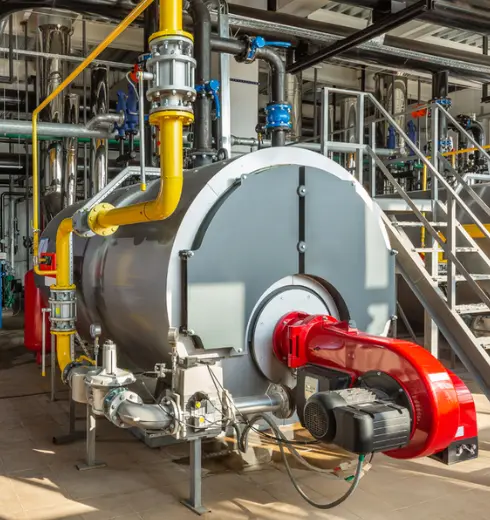
According to Novota’s product brochure, NOVO 800 is suitable for exposure up to approximately 800°C after curing. It has also been tested for 30 minutes of direct flame exposure and reports an electrical resistance test result of 1 megaohm.
Beyond these performance characteristics, one of its important features is its adhesion. The coating is designed to remain bonded to the substrate, offering good adhesion and resistance to peeling and detachment.
For manufacturers, component suppliers, electrical equipment producers and industrial engineering companies, this creates an opportunity to consider a specialised protective coating for components exposed to demanding thermal conditions.
Three Properties in One Coating
01
02
03
04
05
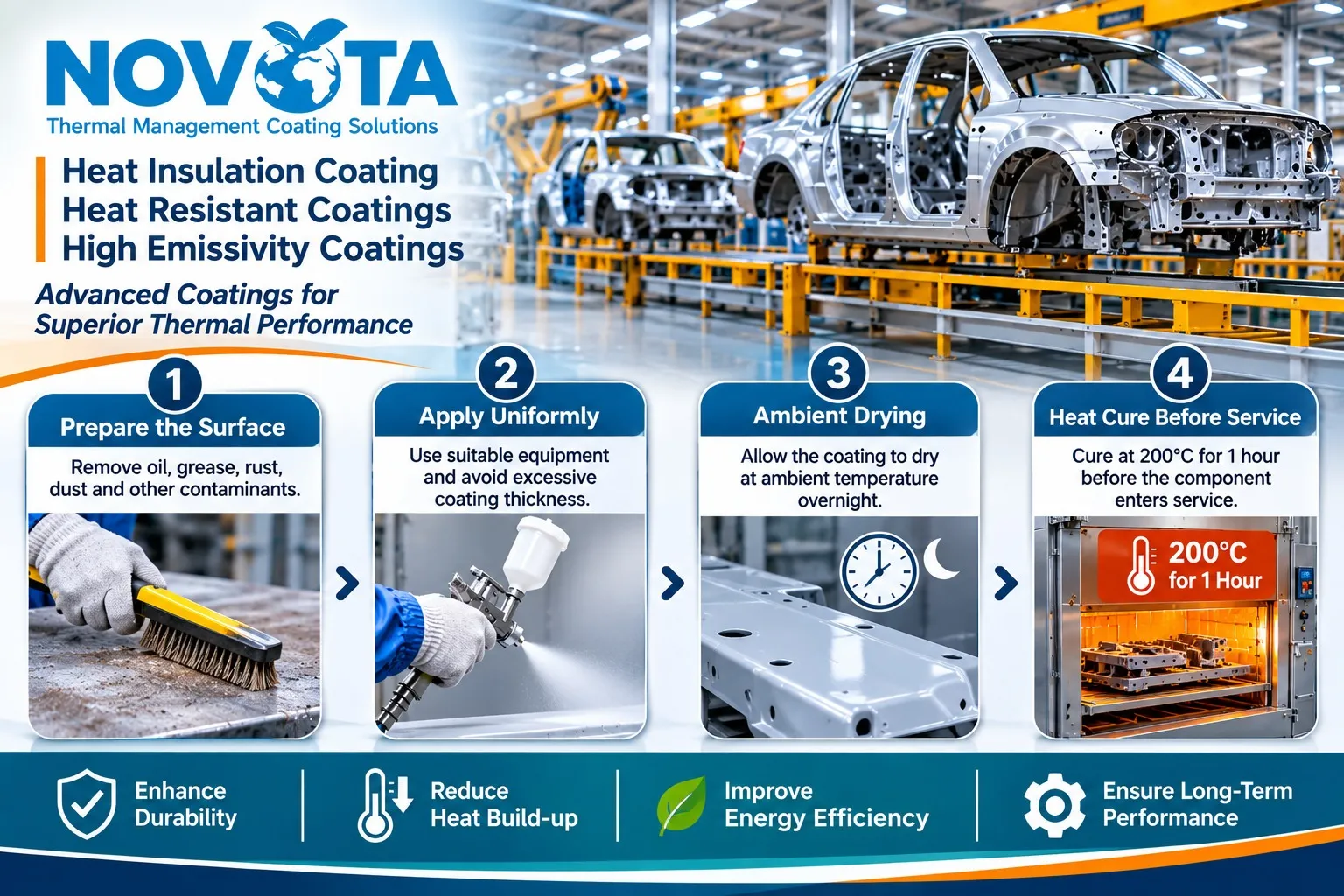
Application Procedure
01
Prepare the surface
02
Apply uniformly
03
Ambient drying
04
Heat cure before service

NOVO 800 at a Glance
| Evaluation parameter | NOVO 800 |
|---|---|
| Product category | Heat-resistant coating |
| Flame resistance | Tested for 30 minutes of direct flame exposure |
| Temperature capability | Up to approximately 800°C after curing |
| Electrical characteristics | Electrically non-conductive |
| Tested electrical resistance | 1 megaohm |
| Substrate | Mild steel components |
| Adhesion | Good adhesion; resistance to peeling and detachment highlighted |
| Ambient drying | Overnight |
| Heat curing | 200°C for 1 hour before service |
Applications
- Mild steel parts in electrical and electronic assemblies
- Where heat exposure and non-conductive surfaces matter
- Subject to component-specific validation
- Selected parts operating at elevated temperatures
- Developed specifically for mild steel
- Washers and small metal components
- Identified in the brochure as an intended application category
- Different geometries, dimensions and service conditions
- Suitability assessed per component and exposure
- Heat, flame and electrical characteristics evaluated together
- Voltage and dielectric needs validated with Novota
- Technical discussion based on the actual component
- Exposure conditions reviewed before specification
Discuss Your Application with Novota Thermotech
Understanding NOVO 800: The Complete Guide
1. What Is a Heat Resistant Coating?
1. What Is a Heat Resistant Coating?
A heat-resistant coating is a specialised protective coating designed to withstand elevated temperatures while maintaining its intended performance.
Unlike conventional paints, which are primarily selected for appearance, general surface protection or corrosion resistance, heat-resistant coatings are developed for applications where thermal exposure is an important operating factor.
Industrial components may experience heat from several sources:
- Direct or indirect flame exposure.
- Electrical resistance and current flow.
- Heated machinery and equipment.
- High-temperature manufacturing processes.
- Proximity to heating elements.
- Thermal exposure during equipment operation.
When an unsuitable coating is exposed to elevated temperatures, it may deteriorate, lose adhesion, change appearance or fail to provide the intended surface properties.
A properly selected heat-resistant coating is designed around the temperature conditions and functional requirements of the application.
However, heat resistance alone is not enough for every industrial requirement.
Some components also require flame resistance, electrical insulation characteristics and dependable adhesion.
This is why NOVO 800 has been developed with a combination of thermal, flame-resistance and electrical properties.
2. Introducing NOVO 800: Three Important Properties in One Coating
2. Introducing NOVO 800: Three Important Properties in One Coating
NOVO 800 is Novota Thermotech’s heat-resistant, flame-resistant and electrically non-conductive coating for mild steel components.
Its positioning is based on three principal characteristics.
A. Heat Resistance
NOVO 800 is designed for exposure up to approximately 800°C after curing.
This makes it relevant to applications where mild steel components encounter elevated temperatures and require a specialised heat-resistant coating.
The approximate temperature capability is an important product-selection parameter. Actual suitability must be confirmed against the component’s exposure conditions, duration, operating environment and application requirements.
B. Flame Resistance
Industrial components may be exposed to direct flame or demanding thermal environments.
NOVO 800 has been tested for 30 minutes of direct flame exposure, according to the product brochure.
This provides an important reference point when evaluating its suitability for applications involving flame exposure.
The reported test duration should not be interpreted as a universal fire-protection rating or certification. Application-specific suitability must be confirmed with Novota.
C. Electrical Insulation
Electrical components require careful consideration of the surface materials and electrical characteristics involved.
NOVO 800 is described as electrically non-conductive, with a tested electrical resistance of 1 megaohm.
This characteristic makes it relevant to selected mild steel components where electrical insulation properties are required alongside heat and flame resistance.
It is important to distinguish electrical resistance from dielectric strength or voltage-withstand capability. These are different measurements. The brochure reports the resistance result, but does not specify a dielectric-strength rating or voltage qualification.
For applications involving defined voltage levels or electrical safety requirements, the relevant technical validation should be discussed with Novota.
3. Why Do Industrial Components Need High Temperature Coatings?
3. Why Do Industrial Components Need High Temperature Coatings?
Temperature is one of the most important factors influencing the long-term performance of industrial materials.
When metal components operate in elevated-temperature environments, their surfaces may experience thermal stress, oxidation, changes in mechanical properties and repeated expansion and contraction.
The coating applied to these components must be suitable for the same operating environment.
Consider an industrial electrical assembly. Certain metal components may experience heat generated during operation or exposure to nearby heat sources. A general-purpose coating may not be suitable for these conditions.
Similarly, metal washers and associated components used in specialised assemblies may require a coating that maintains its adhesion when exposed to heat.
A high-temperature coating can be considered when the application requires a protective surface treatment designed to tolerate elevated temperatures.
However, different high-temperature coatings serve different purposes.
Some are designed primarily for corrosion protection, some for oxidation resistance, some for thermal insulation and others for electrical insulation or specialised surface performance.
The selection should therefore be based on the actual component requirement rather than temperature resistance alone.
Why ordinary paint may not be suitable
General-purpose paints are not necessarily formulated for elevated-temperature service.
Depending on their chemistry and application, they may experience:
- Loss of adhesion.
- Surface deterioration.
- Discolouration.
- Cracking or peeling.
- Changes in protective performance.
- Incompatibility with operating temperatures.
A specialised heat-resistant coating must be selected according to its verified temperature capability and application conditions.
NOVO 800 addresses this requirement with its stated approximate temperature capability of up to 800°C after curing.
4. NOVO 800: Heat Resistant Coating Up to Approximately 800°C
4. NOVO 800: Heat Resistant Coating Up to Approximately 800°C
Temperature capability is one of the first specifications industrial buyers examine when evaluating a high-temperature coating.
A coating may be suitable for moderate-temperature applications but unsuitable for components exposed to significantly higher temperatures.
NOVO 800 is designed for exposure up to approximately 800°C after curing.
This makes it an interesting solution for selected mild steel components that require a heat-resistant coating.
The word “approximately” is important.
The actual operating suitability of any coating depends on factors such as:
- Exposure temperature.
- Exposure duration.
- Heating and cooling cycles.
- Substrate condition.
- Coating application quality.
- Curing procedure.
- Surrounding atmosphere.
- Component geometry and service conditions.
The product’s temperature capability should not automatically be interpreted as a guarantee of continuous operation at 800°C under every condition.
For this reason, Novota recommends discussing the component, exposure conditions and application requirements before finalising product suitability.
Why temperature testing matters
A coating’s performance cannot be judged by its temperature claim alone.
Engineers should also consider whether the coating remains bonded to the substrate and whether it maintains its intended functional properties under the expected conditions.
NOVO 800’s brochure specifically highlights good adhesion and resistance to peeling and detachment.
This is significant because a coating that loses adhesion during service may no longer provide the intended surface protection.
For industrial buyers, the complete performance profile is more meaningful than a temperature number in isolation.
5. Flame Resistant Coating: An Additional Layer of Functional Consideration
5. Flame Resistant Coating: An Additional Layer of Functional Consideration
Heat exposure and flame exposure are related, but they are not identical testing conditions.
A component exposed to a hot environment may experience elevated temperature without direct flame contact.
A component subjected to direct flame experiences a different thermal condition involving intense localised heat exposure.
This distinction matters when selecting an industrial flame-resistant coating.
NOVO 800 has been tested for 30 minutes of direct flame exposure, as stated in Novota’s product brochure.
This test result provides an additional technical consideration beyond its approximate 800°C heat-resistance capability.
Why flame resistance matters in industrial applications
Industrial equipment may contain components located near heating systems, electrical assemblies, hot process areas or other sources of thermal exposure.
In such environments, coating suitability must be evaluated against the actual exposure scenario.
A flame-resistant coating may be considered where the component requires a surface treatment that has been tested under direct flame exposure.
However, a 30-minute direct-flame test result does not automatically establish a fire-resistance classification, fireproofing approval or suitability for structural fire protection.
These applications require separate standards, test methods and qualifications.
NOVO 800 should be evaluated according to the component’s intended use and the specific requirements of the project.
6. Electrical Insulation Coating: Why Non-Conductive Surface Properties Matter
6. Electrical Insulation Coating: Why Non-Conductive Surface Properties Matter
Electrical insulation is a critical consideration in the design and manufacture of electrical and electronic equipment.
Metal components are often incorporated into assemblies where electrical separation, isolation or controlled surface characteristics are required.
Depending on the design, an unsuitable conductive surface may create an unwanted electrical path.
Specialised electrical insulation coatings are developed to provide non-conductive surface characteristics for suitable applications.
NOVO 800 is described as an electrically non-conductive coating, with a tested electrical resistance of 1 megaohm.
This combination of electrical characteristics and heat resistance gives the product a distinct position within the industrial coating category.
Electrical insulation and heat resistance together
In some applications, a component may require both thermal resistance and electrical insulation characteristics.
Using separate coating systems can introduce additional material and process considerations.
A specialised coating designed around multiple functional requirements may simplify the coating-selection process, provided it is validated for the intended application.
NOVO 800 brings together:
- Heat resistance up to approximately 800°C after curing.
- A reported 30-minute direct flame exposure test.
- Electrically non-conductive coating characteristics.
- A tested resistance result of 1 megaohm.
- Good adhesion and resistance to peeling and detachment.
An important engineering consideration
Electrical resistance is not the same as dielectric strength.
A resistance result alone does not establish the maximum operating voltage, insulation class, breakdown voltage, arc resistance or suitability for a particular electrical safety standard.
Engineers and electrical equipment manufacturers should therefore evaluate the complete electrical requirement before specifying the coating.
For applications involving defined voltage levels, insulation coordination or electrical safety approvals, additional technical data and testing may be required.
This is an important part of responsible coating selection.
7. The Importance of Adhesion: Protection That Stays Bonded Under Heat
7. The Importance of Adhesion: Protection That Stays Bonded Under Heat
A high-temperature coating must do more than tolerate heat.
It must also remain attached to the substrate under the intended operating conditions.
Adhesion is the ability of a coating to bond to the underlying material.
When adhesion is inadequate, a coating may peel, detach or separate from the substrate.
This can compromise the coating’s intended function.
The problem becomes particularly important in industrial environments where components experience repeated heating and cooling.
Temperature changes can cause the substrate and coating to expand and contract. Depending on the material properties and application conditions, these movements can place stress on the coating interface.
NOVO 800’s product brochure highlights good adhesion and resistance to peeling and detachment.
This is an important part of its product positioning.
Why coating adhesion depends on preparation
Even a specialised coating may not perform as intended if it is applied over an unsuitable surface.
Oil, grease, rust, dust and other contaminants can interfere with the coating-substrate interface.
For this reason, surface preparation is an essential stage of the NOVO 800 application process.
The product brochure specifies removing oil, grease, rust, dust and contaminants before application.
The coating should then be applied uniformly, avoiding excessive thickness.
These preparation and application steps help establish the conditions required for the intended coating performance.
8. Where Does NOVO 800 Fit? Industrial Applications and Component Suitability
8. Where Does NOVO 800 Fit? Industrial Applications and Component Suitability
NOVO 800 is specifically positioned for mild steel electrical and electronic components, washers and related parts requiring heat resistance, flame resistance and electrical insulation.
This targeted application positioning is important.
Rather than presenting the product as a general-purpose coating for every industrial surface, Novota identifies a category of components where its combined properties may be relevant.
Potential application areas for evaluation include:
8.1 Electrical and electronic components
Electrical and electronic assemblies may incorporate mild steel parts that require specialised surface characteristics.
Where elevated-temperature exposure and non-conductive coating properties are important, NOVO 800 may be considered subject to component-specific validation.
8.2 Mild steel components
Mild steel is widely used in industrial manufacturing because of its versatility and suitability for fabrication.
Selected mild steel components operating in elevated-temperature environments may require specialised coating solutions.
NOVO 800 has been developed specifically for mild steel components.
8.3 Industrial washers and related parts
Washers and small metal components are used across a wide range of industrial assemblies.
In specialised applications, these components may require more than conventional surface treatment.
NOVO 800’s brochure specifically identifies washers and related parts as part of its intended application category.
8.4 Specialised manufactured components
Manufacturers frequently work with components having different geometries, dimensions and service conditions.
For such applications, coating suitability should be assessed according to the component’s material, operating temperature, exposure duration and functional requirements.
Novota encourages customers to discuss their component and exposure conditions to assess suitability.
Application suitability should always be confirmed
The presence of an electrical component or mild steel substrate does not automatically establish suitability.
Component size, geometry, electrical design, operating conditions and coating requirements must all be considered.
NOVO 800 is best evaluated through a technical discussion based on the actual component.
9. NOVO 800 Application Procedure: Preparation, Coating, Drying and Curing
9. NOVO 800 Application Procedure: Preparation, Coating, Drying and Curing
A coating’s performance depends not only on its formulation but also on how it is applied.
Surface preparation, uniform application, drying and curing are important stages in the coating process.
Novota’s NOVO 800 brochure specifies the following application sequence.
Step 1: Prepare the surface
Before application, remove:
- Oil.
- Grease.
- Rust.
- Dust.
- Other contaminants.
The objective is to prepare a clean surface suitable for coating application.
The preparation process should be appropriate for the component and its condition.
Step 2: Apply the coating uniformly
Apply NOVO 800 uniformly using suitable application equipment.
Avoid excessive coating thickness.
Uniform application is important because unnecessary variations in coating thickness can affect the consistency of the finished surface.
The application equipment and process should be selected according to the component geometry and production requirements.
Step 3: Allow ambient drying
After application, allow the coating to dry at ambient temperature overnight.
This is the drying stage specified in the product brochure.
Adequate drying is important before proceeding to the curing stage.
Step 4: Cure before service
NOVO 800 requires heat curing at:
200°C for 1 hour before service.
This is an important part of the application process.
The coating should not be placed into service without following the specified curing procedure.
Manufacturers should plan their production process accordingly, including the availability of suitable curing equipment and controlled heating conditions.
Why application discipline matters
A specialised industrial coating should be applied according to its specified procedure rather than treated like ordinary decorative paint.
Incorrect surface preparation, excessive thickness, inadequate drying or incomplete curing may affect the final coating performance.
Following the recommended application sequence helps create a more consistent coating process.
10. NOVO 800 Compared with Conventional Heat Resistant Paint
10. NOVO 800 Compared with Conventional Heat Resistant Paint
The terms heat resistant paint and heat resistant coating are frequently used interchangeably in industrial purchasing.
However, different products are designed for different functions.
A conventional heat-resistant paint may primarily be selected for a durable finish on metal surfaces exposed to elevated temperatures.
Other coating systems may be designed to provide corrosion protection, oxidation resistance, thermal insulation or specialised electrical characteristics.
NOVO 800 has a more specific functional positioning.
| Evaluation parameter | NOVO 800 |
|---|---|
| Product category | Heat-resistant coating |
| Flame resistance | Tested for 30 minutes of direct flame exposure |
| Temperature capability | Up to approximately 800°C after curing |
| Electrical characteristics | Electrically non-conductive |
| Tested electrical resistance | 1 megaohm |
| Substrate | Mild steel components |
| Adhesion | Good adhesion; resistance to peeling and detachment highlighted |
| Ambient drying | Overnight |
| Heat curing | 200°C for 1 hour before service |
The difference is not simply the temperature rating.
NOVO 800 combines heat resistance, flame resistance and electrical insulation characteristics in a coating developed for a defined component category.
This is what makes it worth evaluating for specialised industrial requirements.
11. What Should Manufacturers Consider Before Selecting a High Temperature Coating?
11. What Should Manufacturers Consider Before Selecting a High Temperature Coating?
Selecting a high-temperature coating requires a clear understanding of the component and its service environment.
Before specifying NOVO 800, manufacturers and engineering teams should consider the following factors.
Operating temperature
What temperature will the component experience during normal operation?
Will it experience occasional temperature peaks or repeated thermal exposure?
The coating’s approximate temperature capability must be assessed against these conditions.
Exposure duration
How long will the component remain exposed to elevated temperatures?
A short-duration exposure and continuous operating exposure are different requirements.
Flame exposure
Will the component experience direct flame, radiant heat or indirect thermal exposure?
The reported direct-flame test result should be evaluated in relation to the actual application.
Electrical requirements
What electrical resistance or insulation characteristics does the component require?
If a particular voltage withstand, dielectric strength or safety certification is required, additional technical validation should be obtained.
Substrate material
Is the component manufactured from mild steel?
NOVO 800 is specifically identified for mild steel components in its brochure. Other substrates should not be assumed suitable without confirmation.
Component geometry
Is the component flat, curved, perforated or irregular?
The application procedure must provide uniform coating coverage while avoiding excessive thickness.
Production and curing facilities
Can the manufacturer provide ambient drying overnight followed by curing at 200°C for one hour?
This should be considered when integrating NOVO 800 into a production line.
A structured evaluation helps ensure that the selected coating is appropriate for the actual engineering requirement.
12. Why Choose Novota Thermotech for Specialised Industrial Coatings?
12. Why Choose Novota Thermotech for Specialised Industrial Coatings?
Industrial coating selection should be based on more than a product name or a temperature claim.
It requires an understanding of materials, operating conditions, surface preparation, coating application and the intended performance of the finished component.
Novota Thermotech develops specialised coating technologies for industrial thermal-management and surface-engineering requirements.
Its product portfolio addresses different application needs, including high-emissivity coatings such as emiSEAL High Emissivity Coating, heat dissipation coatings such as HeatXperse Heat Dissipation Coating and specialised thermal protection technologies.
With the introduction of NOVO 800, Novota adds a product specifically positioned around the combined requirements of heat resistance, flame resistance and electrical insulation for mild steel components.
For industrial customers, this creates an opportunity to discuss a specialised coating requirement directly with the manufacturer.
Whether the requirement involves electrical and electronic components, mild steel washers or related manufactured parts, the first step is to understand the actual service conditions.
Novota’s technical team can discuss the component, exposure conditions and application needs to assess suitability.
NOVO 800 is not simply another heat-resistant paint. It is a specialised coating developed for applications where thermal exposure, flame resistance, electrical characteristics and adhesion must be considered together.
13. The Future of Industrial Coatings: Moving Beyond Conventional Surface Protection
13. The Future of Industrial Coatings: Moving Beyond Conventional Surface Protection
Industrial surface engineering continues to evolve.
Manufacturers are increasingly looking for coatings that perform specific functions rather than providing only a conventional protective finish.
Some applications require corrosion resistance. Others require thermal insulation, high emissivity, heat dissipation, electrical insulation or resistance to elevated temperatures.
These requirements are creating opportunities for specialised coating technologies.
The future of industrial coatings will depend on understanding the interaction between coating materials, substrates and operating environments.
NOVO 800 represents Novota Thermotech’s approach to one such requirement: combining heat resistance, flame resistance and electrical insulation characteristics in a coating developed for mild steel components.
Its approximate 800°C temperature capability after curing, reported direct-flame test duration of 30 minutes and tested electrical resistance of 1 megaohm provide important starting points for technical evaluation.
But the real measure of a successful coating is its suitability for the component and its actual service conditions.
That is why Novota encourages application-specific technical discussions rather than relying on temperature ratings alone.
NOVO 800 – Built for Heat. Engineered to Adhere.
Frequently Asked Questions About NOVO 800 Heat Resistant Coating
1. What is NOVO 800 coating?
NOVO 800 is a heat-resistant, flame-resistant and electrically non-conductive coating developed by Novota Thermotech for mild steel components.
2. What is the temperature resistance of NOVO 800?
NOVO 800 is designed for exposure up to approximately 800°C after curing. Actual application suitability should be confirmed with Novota based on the component’s operating conditions.
3. Is NOVO 800 a flame-resistant coating?
Yes. The product brochure reports that NOVO 800 has been tested for 30 minutes of direct flame exposure. This result should not be interpreted as a universal fire-resistance certification.
4. Is NOVO 800 electrically insulating?
NOVO 800 is described as electrically non-conductive, with a tested electrical resistance of 1 megaohm. Applications requiring specific voltage or dielectric-strength ratings should be technically validated.
5. Which materials can NOVO 800 be applied to?
The brochure identifies mild steel components as the intended substrate. Other materials should not be assumed compatible without confirmation from Novota.
6. Can NOVO 800 be used on electrical and electronic components?
NOVO 800 is specifically positioned for mild steel electrical and electronic components, washers and related parts requiring heat resistance, flame resistance and electrical insulation.
7. How is NOVO 800 applied?
The specified procedure involves removing oil, grease, rust, dust and contaminants, applying the coating uniformly using suitable equipment, allowing it to dry at ambient temperature overnight and then curing it at 200°C for one hour before service.
8. Does NOVO 800 require heat curing?
Yes. The brochure specifies heat curing at 200°C for one hour before service.
9. Is NOVO 800 suitable for continuous exposure at 800°C?
The brochure states a temperature capability of up to approximately 800°C after curing. It does not specify a universal continuous-service duration. The actual operating conditions should be discussed with Novota.
10. What makes NOVO 800 different from ordinary heat-resistant paint?
NOVO 800 combines heat resistance, tested direct-flame exposure performance and electrically non-conductive coating characteristics. It is developed for mild steel components requiring these combined properties.
11. Does NOVO 800 resist peeling and detachment?
Novota’s product brochure highlights good adhesion and resistance to peeling and detachment.
12. How can I enquire about NOVO 800?
Manufacturers and industrial buyers can contact Novota Thermotech with their component details, substrate information and exposure conditions to discuss product suitability.
Discuss Your Application with Novota Thermotech
Looking for a specialised heat resistant coating for mild steel components? Need a flame-resistant and electrically non-conductive coating for selected electrical or electronic parts? Explore NOVO 800 by Novota Thermotech.
NOVOTA THERMOTECH PVT. LTD.
Thane, Maharashtra, India
Email: info@novota.in
Phone: +91 22 44812529
Website: https://novota.in/
NOVO 800 – Built for Heat. Engineered to Adhere.