
Heat Resistant Paint for Roof: Benefits, Types, Applications and How to Choose the Right Roof Coating in India
Primary SEO Keyword: Heat Resistant Paint for Roof
SEO Title: Heat Resistant Paint for Roof: Benefits, Types & Best Solutions in India
Meta Description: Looking for heat resistant paint for roof? Discover how heat-reflective coatings help reduce roof heat absorption, improve indoor comfort and support energy efficiency in Indian homes, factories and commercial buildings.
Suggested URL Slug: /heat-resistant-paint-for-roof/
Heat Resistant Paint for Roof: A Smarter Way to Manage Heat and Improve Building Comfort
The roof is one of the most exposed parts of any building. Throughout the day, it receives direct sunlight, absorbs solar radiation and experiences continuous temperature variations. In countries like India, where summer temperatures can rise significantly, roof surfaces can become extremely hot, transferring unwanted heat into the building below.
Whether it is a residential home, industrial factory, commercial building, warehouse, office, school or manufacturing facility, excessive roof heating can create uncomfortable indoor conditions and increase the demand for air conditioning and other cooling systems.
This is why the demand for heat resistant paint for roof applications is growing.
Modern roof coating technologies offer more than just an additional layer of paint. Specially engineered coatings can help protect surfaces against elevated temperatures, reduce solar heat absorption, improve the durability of roof surfaces and contribute to better thermal management.
However, it is important to understand that not all roof paints perform the same function. Some coatings are designed to withstand high temperatures, while others are formulated to reflect solar radiation and reduce heat absorption. Selecting the right coating depends on the roof material, environmental conditions and the thermal challenge that needs to be addressed.
With advancements in coating technology, property owners and industrial facility managers now have more options to manage roof temperatures through specialised surface engineering.
In this comprehensive guide, we explore how heat resistant paint for roof applications works, its benefits, different coating technologies, applications, selection criteria and how advanced heat-reflective coatings can contribute to energy efficiency and sustainable building management.
1. Why Does Your Roof Become So Hot?
To understand the importance of heat resistant paint for roof applications, it is necessary to understand how roofs absorb and transfer heat.
Solar radiation reaches the roof throughout the day. Depending on the roofing material, colour, surface condition and surrounding environment, a significant proportion of this energy may be absorbed by the roof.
Materials such as metal sheets, concrete, asbestos-cement sheets and other conventional roofing materials can become hot under prolonged exposure to sunlight.
The absorbed solar energy increases the surface temperature of the roof. This heat can then travel through the roofing structure and contribute to higher indoor temperatures.
Several factors influence roof heating:
Direct sunlight: Roofs exposed to sunlight for extended periods receive greater solar energy.
Roof colour: Dark-coloured surfaces generally absorb more solar radiation than lighter, highly reflective surfaces.
Roofing material: Metal, concrete and other materials have different thermal properties that influence how they absorb, store and transfer heat.
Roof insulation: Buildings with insufficient insulation may experience greater heat transfer from the roof into indoor spaces.
Ambient temperature: High outdoor temperatures can further increase the thermal burden on exposed roofing structures.
Building design: Roof orientation, ventilation, construction methods and surrounding structures also influence overall thermal performance.
In industrial buildings and warehouses, large roof areas can make this problem particularly significant.
A factory with thousands of square feet of exposed metal roofing may experience substantial solar heat gain during summer months. This can affect working conditions, increase cooling requirements and make temperature management more challenging.
A suitable roof coating can help address part of this problem by changing how the roof surface interacts with incoming solar energy.
2. What Is Heat Resistant Paint for Roof?
Heat resistant paint for roof is a specialised coating designed for roofing surfaces that experience elevated temperatures and demanding environmental conditions.
Depending on its formulation, a heat-resistant coating may help withstand high surface temperatures, protect the substrate against thermal exposure and maintain coating performance under specified operating conditions.
However, there is an important difference between heat-resistant paint and heat-reflective roof coating.
Heat-resistant paint
Heat-resistant paint is generally formulated to withstand elevated temperatures without unacceptable degradation, peeling, blistering or loss of adhesion within its specified temperature range.
It is commonly used on applications such as:
- Industrial equipment and machinery.
- Boilers and associated components.
- Chimneys and exhaust systems.
- Industrial pipelines.
- Metal surfaces exposed to high temperatures.
- Furnaces and other heat-generating equipment.
For roofing, the coating must be specifically suitable for the roofing material, weather exposure and expected operating conditions.
Heat-reflective roof coating
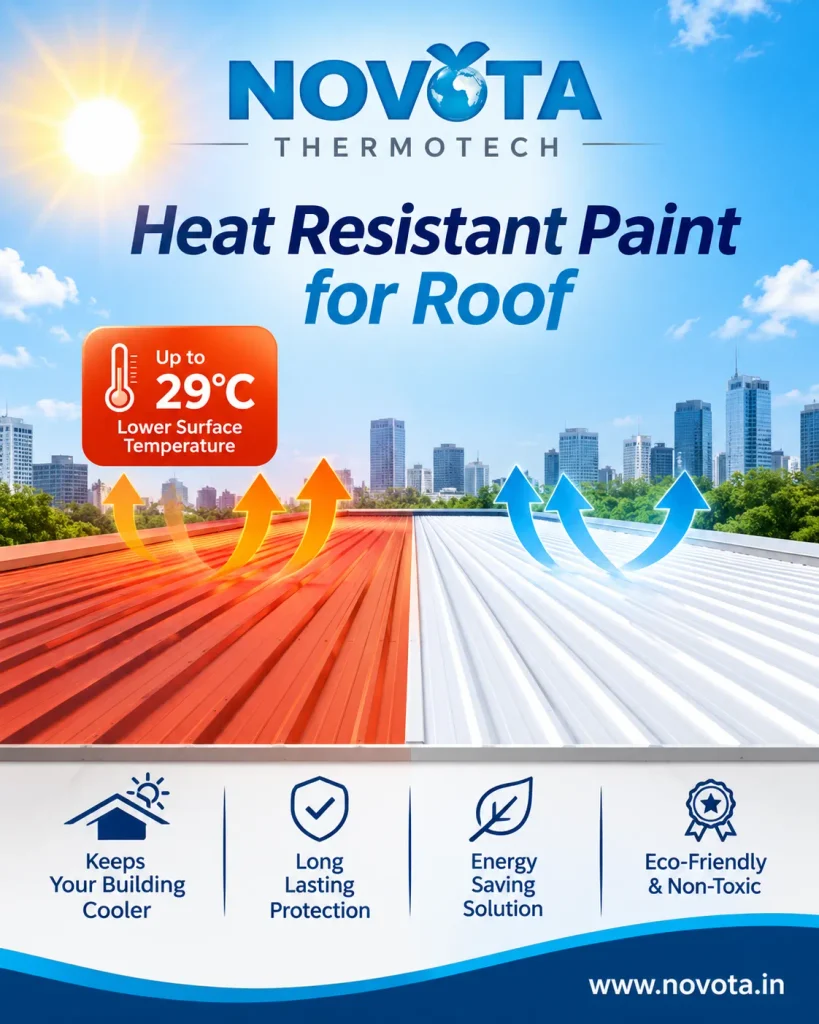
Heat-reflective roof coatings are designed to reflect a greater proportion of incoming solar radiation, helping reduce the amount of solar energy absorbed by the roof surface.
These coatings are particularly relevant for buildings exposed to intense sunlight.
Depending on the coating formulation, they may offer:
- High solar reflectance.
- Reduced solar heat absorption.
- Lower roof surface temperatures under suitable conditions.
- Improved indoor thermal comfort.
- Potential reduction in building cooling demand.
A high-albedo roof coating is one example of this approach.
The key takeaway is that a coating designed to withstand high temperatures is not automatically a coating designed to reflect solar heat.
For buildings experiencing excessive summer heat, selecting a suitable solar-reflective roof coating may be more relevant than simply choosing a paint labelled heat resistant.
3. How Does Heat Reflective Paint for Roof Work?
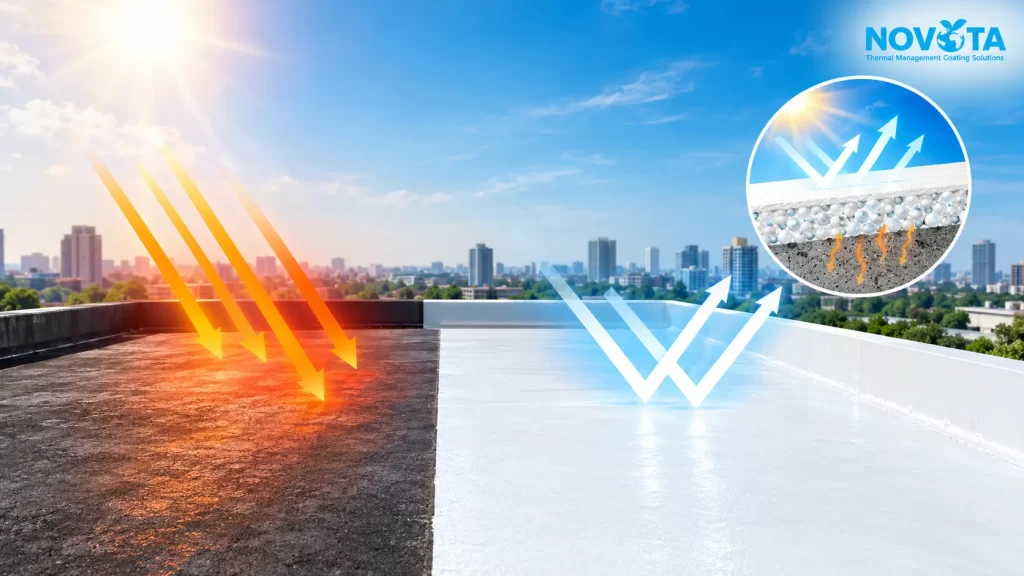
A roof coating designed for solar heat management works by influencing the interaction between sunlight and the roof surface.
When sunlight reaches a roof, its energy can be reflected, absorbed or transmitted.
A conventional dark roof may absorb a significant portion of incoming solar radiation. This absorbed energy increases the temperature of the roofing material.
A suitably formulated reflective coating changes the surface characteristics, allowing a greater proportion of incoming solar radiation to be reflected.
This helps reduce the amount of solar energy absorbed by the roof.
The process can be understood through four stages:
Stage 1: Solar radiation reaches the roof.
The roof is exposed to sunlight and receives solar energy throughout the day.
Stage 2: The coating reflects solar radiation.
A high-albedo coating reflects a greater proportion of incoming solar energy instead of allowing the surface to absorb it.
Stage 3: Less solar energy is absorbed.
With lower solar absorption, the roof surface may experience a lower temperature compared with an otherwise similar uncoated surface under comparable conditions.
Stage 4: Heat transfer into the building may decrease.
Reduced roof heat gain can help limit the amount of heat transferred into the building, depending on insulation, construction and ventilation.
This is the fundamental principle behind cool roof technology.
It is especially useful in regions where buildings experience prolonged exposure to intense sunlight.
4. Major Benefits of Heat Resistant Paint for Roof
Choosing an appropriate specialised roof coating can offer several advantages. The actual benefits depend on the product formulation, substrate, preparation, application quality and environmental conditions.
4.1 Helps Reduce Roof Surface Temperature
One of the primary reasons people search for heat resistant paint for roof is the need to reduce excessive roof heating.
A solar-reflective coating can help reduce solar energy absorption, resulting in lower roof surface temperatures under suitable conditions.
This is particularly beneficial for:
- Metal sheet roofs.
- Industrial sheds.
- Warehouses.
- Commercial buildings.
- Residential terraces.
- Concrete rooftops.
- Manufacturing facilities.
Reducing roof heat gain can be an important first step towards improving overall building thermal performance.
4.2 Improves Indoor Thermal Comfort
A hot roof can contribute to uncomfortable indoor conditions, particularly in buildings without adequate insulation.
By reducing the solar heat absorbed by the roof, a suitable reflective coating may help reduce heat transfer into the occupied space.
This can contribute to more comfortable working and living environments.
For factories, this is particularly important because employees may spend long hours working inside large buildings with extensive exposed roofing.
4.3 Supports Energy Efficiency
Cooling systems consume energy to maintain comfortable indoor temperatures.
When a building experiences substantial solar heat gain through its roof, air conditioning and other cooling systems may need to work harder.
A suitable roof heat-reflective coating can help reduce this external heat gain.
This may support lower cooling demand and improved building energy efficiency, particularly in buildings where roof heat gain is a significant contributor to the cooling load.
The actual energy savings depend on several factors, including:
- Building size.
- Roof construction.
- Existing insulation.
- Air-conditioning capacity.
- Occupancy.
- Local weather conditions.
- Roof coating performance.
It is important to evaluate actual building conditions before estimating energy savings.
4.4 Helps Protect Roofing Surfaces
Specialised roof coatings can provide an additional protective layer over suitable substrates.
Depending on the formulation, this layer may help protect the roof against environmental exposure, weathering and surface deterioration.
Some coating systems also provide resistance to moisture, corrosion or other environmental stresses.
However, these properties must be verified through the product’s technical specifications.
A heat-reflective coating should not automatically be assumed to be waterproof, anticorrosive or suitable for every roofing substrate.
4.5 Contributes to Sustainable Building Management
Energy efficiency is becoming an important consideration in modern building design and facility management.
Reducing unnecessary solar heat absorption is one way to improve the thermal performance of building envelopes.
Reflective roof coatings can contribute to this objective without necessarily requiring major structural modifications.
They can be considered as part of a broader sustainability strategy involving insulation, efficient cooling systems, ventilation and energy management.
4.6 Suitable for Large Industrial Roof Areas
Industrial facilities often have extensive roof areas exposed to direct sunlight.
This makes roof surface engineering particularly relevant for factories, warehouses, logistics centres and manufacturing plants.
A suitable coating can help manage solar heat gain across large roofing surfaces.
The potential benefit becomes especially important when considered as part of a long-term facility energy-efficiency programme.
5. Different Types of Heat Resistant and Heat Reflective Roof Coatings
There is no single coating suitable for every roofing application.
Different products are developed for different performance requirements.
Understanding the available technologies helps property owners and facility managers make better decisions.
5.1 Solar Reflective Roof Coatings
Solar-reflective coatings are designed to reflect incoming solar radiation.
They are particularly suitable for buildings where excessive solar heat absorption is a major concern.
These coatings are often used on:
- Industrial roofs.
- Commercial buildings.
- Warehouses.
- Residential terraces.
- Metal roofing.
- Concrete roofs.
Their primary function is to reduce solar heat gain rather than simply withstand high temperatures.
5.2 High-Albedo Roof Coatings
Albedo refers to the proportion of incoming solar radiation reflected by a surface.
A high-albedo roof coating has greater solar reflectance compared with a conventional surface of lower reflectivity.
Such coatings can help reduce the amount of solar energy absorbed by exposed roofing surfaces.
Their effectiveness depends on the coating’s measured solar reflectance and its ability to retain performance over time.
5.3 High-Emissivity Coatings
High-emissivity coatings are engineered to radiate thermal energy effectively.
Thermal emissivity describes how efficiently a surface emits thermal radiation compared with an ideal blackbody at the same temperature.
These coatings can support radiative heat dissipation from appropriate hot surfaces and equipment.
They are relevant to industrial thermal management, where managing the temperature of equipment, enclosures and other hot surfaces is important.
However, high emissivity and solar reflectance are different properties.
A coating with high emissivity is not necessarily highly reflective to incoming sunlight.
5.4 High-Temperature Resistant Industrial Paints
Some industrial paints are formulated to withstand elevated operating temperatures.
They are commonly used on metal equipment, pipelines, chimneys, exhaust systems and other components exposed to high temperatures.
The maximum service temperature depends on the product chemistry and manufacturer specifications.
These coatings should be selected according to the actual temperature range and substrate requirements.
5.5 Elastomeric Roof Coatings
Elastomeric coatings are flexible coating systems designed to accommodate certain levels of substrate movement and thermal expansion.
Depending on the formulation, they may offer weather resistance, flexibility and protection against water penetration.
Some elastomeric roof coatings also incorporate solar-reflective properties.
Their suitability depends on the roof material, movement characteristics and exposure conditions.

6. Heat Resistant Paint for Metal Roofs and Industrial Sheds
Metal roofing is widely used in Indian industrial and commercial buildings.
Factories, warehouses, workshops, logistics facilities and manufacturing units often use metal sheets because they are relatively lightweight and allow faster construction.
However, metal roofs exposed to direct sunlight can become significantly hot.
The large exposed surface area can contribute to considerable solar heat gain.
Applying an appropriate heat-reflective roof coating can help reduce the solar energy absorbed by these surfaces.
Why metal roofs need specialised coatings
Metal roofing has specific requirements.
The coating must be compatible with the metal substrate and provide suitable adhesion.
Other considerations include:
- Surface rust and corrosion.
- Existing paint condition.
- Thermal expansion and contraction.
- Roof slope.
- Exposure to rain and humidity.
- Surface contamination.
- Maintenance requirements.
Before applying a coating, the roof should be inspected and prepared according to the manufacturer’s recommendations.
Benefits for factories and warehouses
A suitable reflective roof coating may help:
- Reduce solar heat absorption.
- Improve indoor thermal conditions.
- Reduce the thermal burden on cooling systems.
- Support better working conditions.
- Contribute to building energy-efficiency objectives.
For large industrial facilities, a professional roof assessment is recommended before selecting the coating system.
7. Heat Resistant Paint for Concrete Roofs and Residential Terraces
Concrete roofs and terraces are common in Indian residential and commercial buildings.
During summer, exposed concrete surfaces absorb solar energy and can become extremely hot.
This heat can gradually influence indoor temperatures, particularly in top-floor rooms.
A suitable solar-reflective roof coating can help reduce solar heat absorption.
Why residential buildings need roof heat management
Many Indian homes experience excessive heat during summer, especially on upper floors.
Common problems include:
- Hot terrace surfaces.
- Increased indoor temperatures.
- Greater dependence on air conditioning.
- Uncomfortable bedrooms during afternoons.
- Heat retention after sunset.
A suitable roof coating may help address part of the solar heat gain problem.
What should homeowners consider?
Before selecting a product, homeowners should evaluate:
- Concrete surface condition.
- Existing waterproofing treatment.
- Cracks and damaged areas.
- Moisture and leakage problems.
- Roof drainage.
- Compatibility with previous coatings.
- Required surface preparation.
If the roof has leakage or structural cracks, these problems should be addressed separately using an appropriate repair or waterproofing system.
A reflective coating should not be treated as an automatic substitute for waterproofing.
8. Heat Resistant Paint for Roofs in Indian Weather Conditions
India presents diverse climatic conditions.
Different regions experience different combinations of heat, humidity, rainfall, dust, coastal exposure and temperature variations.
Therefore, a roof coating suitable for one location may not necessarily perform identically in another.
Hot and dry regions
Regions experiencing prolonged summer heat and strong solar radiation may benefit from suitable high-reflectance roof coatings.
Reducing solar heat absorption can be particularly relevant for large exposed roofs.
Coastal regions
Coastal areas experience humidity, salt exposure and moisture-related challenges.
Roof coating selection should consider corrosion protection, adhesion and resistance to the local environment.
High-rainfall regions
Buildings exposed to heavy monsoon rainfall need coatings compatible with frequent wetting and drying.
Roof drainage, substrate condition and moisture management are especially important.
Urban environments
Urban buildings can experience additional thermal challenges due to surrounding structures, paved surfaces and limited ventilation.
Roof reflectivity can contribute to reducing solar heat absorption, although the overall urban heat environment involves many other factors.
For Indian conditions, the most suitable coating is one that matches the actual roof material, local climate and required thermal performance.
9. How to Choose the Best Heat Resistant Paint for Roof
Selecting the right product is more important than simply choosing a coating based on its name or advertised temperature resistance.
Here are the major factors to evaluate.
1. Identify the actual problem
Is the roof becoming hot due to direct solar exposure?
Is the requirement to protect equipment against high operating temperatures?
Is the roof experiencing corrosion, water leakage or weathering?
Different problems require different coating technologies.
2. Check solar reflectance
If the primary objective is to reduce roof heat absorption, examine the product’s solar reflectance data.
A higher solar reflectance generally means a greater proportion of incoming solar radiation is reflected.
Ask for relevant test reports rather than relying only on marketing descriptions.
3. Evaluate thermal emissivity
If the requirement involves radiative heat dissipation, check the coating’s thermal emissivity.
Remember that emissivity and solar reflectance measure different surface properties.
Both can be relevant to thermal management, but they serve different purposes.
4. Check substrate compatibility
The product should be suitable for the surface on which it will be applied.
Different requirements apply to:
- Galvanised iron sheets.
- Aluminium sheets.
- Mild steel.
- Concrete.
- Cement sheets.
- Previously coated surfaces.
5. Examine weather resistance
The roof coating must withstand the environmental conditions in which it will operate.
Check the manufacturer’s specifications for UV exposure, moisture, temperature cycling and other relevant properties.
6. Understand application requirements
A good coating can underperform if applied incorrectly.
Check the recommended surface preparation, primer requirements, application thickness, number of coats and curing conditions.
7. Evaluate long-term performance
Do not compare products only on initial purchase price.
Consider the expected service life, maintenance requirements, reapplication needs and overall lifecycle cost.
8. Request technical documentation
Before finalising a coating, request:
- Technical Data Sheet.
- Safety Data Sheet.
- Solar reflectance information, where applicable.
- Thermal emissivity data, where applicable.
- Adhesion test information.
- Weathering test results.
- Application instructions.
- Recommended substrate details.
A technically documented product provides a stronger basis for selection.
10. How Is Heat Resistant Roof Paint Applied?
Correct application plays a major role in coating performance.
Even an advanced coating may not deliver its intended results if the roof is not properly prepared.
The general application process involves the following steps.
Step 1: Roof Inspection
Inspect the entire roof to identify rust, cracks, damaged areas, old paint, loose material and moisture-related problems.
Determine the substrate and existing coating condition.
Step 2: Surface Cleaning
Remove dust, dirt, grease, loose paint, corrosion products and other contaminants.
The surface should meet the cleanliness requirements specified by the coating manufacturer.
Step 3: Surface Repairs
Repair damaged sections, cracks and other defects using suitable materials.
Address water leakage and drainage issues separately where necessary.
Step 4: Primer Application
Depending on the substrate and coating system, a compatible primer may be required.
Primer selection should follow the manufacturer’s recommendations.
Step 5: Coating Application
Apply the coating using the recommended method.
Depending on the product, application may involve brushes, rollers or spray equipment.
Follow the specified coverage, wet-film thickness, dry-film thickness and number of coats.
Step 6: Drying and Curing
Allow the coating to dry and cure under the recommended environmental conditions.
Avoid premature exposure to rain, water or mechanical stress where the product instructions require protection.
Step 7: Final Inspection
Inspect the completed coating for uniform coverage, adhesion, defects and other application-related issues.
Following the correct application procedure helps achieve more consistent coating performance.
11. Common Mistakes to Avoid When Buying Roof Heat Resistant Paint
Many property owners select roof paints based on price, colour or broad advertising claims.
This can lead to disappointing results.
Some common mistakes include:
Choosing ordinary white paint: A white colour does not automatically guarantee high solar reflectance or long-term reflective performance.
Confusing heat resistance with heat reflection: A paint that withstands high temperatures may not necessarily reduce solar heat absorption.
Ignoring surface preparation: Dirt, rust and loose coatings can affect adhesion and durability.
Expecting waterproofing from every roof coating: Not every reflective or heat-resistant paint is designed to stop water leakage.
Ignoring technical specifications: Product performance should be supported by appropriate technical data.
Applying insufficient coating thickness: The specified application thickness is important for achieving the intended performance.
Ignoring maintenance: Dust, pollution and weathering can affect the performance of exposed roof coatings over time.
The right approach is to select a coating based on its intended function and verified technical properties.
12. Can Heat Resistant Paint Reduce Electricity Bills?
This is one of the most common questions asked by homeowners and industrial facility managers.
The answer depends on the coating type and the building’s thermal characteristics.
A suitable solar-reflective roof coating can reduce the amount of solar energy absorbed by the roof.
When roof heat gain is a significant contributor to indoor cooling demand, this reduction may help air-conditioning systems operate under a lower thermal load.
This can contribute to energy savings.
However, the actual savings are not identical for every building.
They depend on:
- Roof area.
- Existing roof insulation.
- Indoor temperature requirements.
- Cooling system efficiency.
- Building occupancy.
- Local climate.
- Operating hours.
- Solar reflectance and coating condition.
For example, a large factory operating air-conditioning systems for extended periods may have different savings potential from a naturally ventilated warehouse.
A proper energy assessment is the best way to estimate the financial benefits of a roof coating project.
13. Heat Resistant Paint vs. Traditional Roof Paint
Understanding the difference between conventional roof paint and specialised coatings helps in making the right decision.
Traditional decorative paints are generally selected for appearance and basic surface protection.
Specialised roof coatings are engineered for specific performance requirements.
| Parameter | Conventional Roof Paint | Specialised Roof Coating |
|---|---|---|
| Primary purpose | Appearance and general protection | Defined thermal or protective performance |
| Solar reflectance | Depends on formulation | Can be specifically engineered for higher reflectance |
| Thermal emissivity | Varies | Can be engineered for specific emissivity requirements |
| Weather resistance | Depends on product | Depends on specialised formulation |
| High-temperature resistance | Not necessarily | Available in suitable formulations |
| Technical performance data | Varies | Should be evaluated through relevant test data |
| Industrial suitability | Product dependent | Available for specialised industrial applications |
The best choice depends on whether the requirement is decorative protection, solar heat reflection, high-temperature resistance or a combination of these functions.
14. Applications of Heat Resistant and Heat Reflective Roof Coatings
Specialised coatings have applications across residential, commercial and industrial infrastructure.
Residential Buildings
Suitable roof coatings can help manage solar heat absorption in independent houses, apartment buildings, terraces and residential complexes.
Industrial Factories
Large industrial roofs exposed to sunlight can benefit from suitable reflective roof coating systems.
Warehouses and Logistics Centres
Warehouses often have extensive metal roofing and large internal volumes.
Roof heat management can contribute to improved indoor conditions and facility energy-efficiency efforts.
Commercial Complexes
Shopping centres, offices, showrooms and commercial buildings can consider reflective roof coatings as part of their building-envelope strategy.
Educational Institutions
Schools, colleges and other institutions can evaluate roof coating solutions to improve thermal comfort in classrooms and common areas.
Hospitals and Healthcare Facilities
Healthcare buildings require carefully managed indoor environments.
Appropriate roof coatings can contribute to the overall thermal performance of the building envelope.
Manufacturing Plants
Manufacturing facilities may require different coating technologies for external roofs and internal heat-generating equipment.
The coating must be selected according to the temperature conditions and intended function.
15. Why Advanced Surface Engineering Matters for Thermal Management
The future of thermal management is not limited to conventional cooling systems.
Materials and surface engineering can also play an important role in controlling how heat interacts with buildings, equipment and infrastructure.
Two important surface properties are particularly relevant.
Solar reflectance: The ability of a surface to reflect incoming solar radiation.
Thermal emissivity: The ability of a surface to emit thermal radiation.
These properties can be engineered through specialised coating formulations.
For example, a high-albedo roof coating can help reduce solar heat absorption.
A high-emissivity coating can support radiative heat dissipation from suitable hot surfaces and equipment.
These technologies address different aspects of thermal management.
When selected and applied appropriately, they can complement insulation, ventilation, mechanical cooling and other energy-efficiency measures.
This broader approach is increasingly relevant for industrial infrastructure, commercial buildings and facilities with demanding thermal requirements.
16. Novota Thermotech: Advanced Coating Technologies for Heat Management
At Novota Thermotech, we focus on advanced coating technologies designed to address thermal challenges across industrial and building applications.
Our patented coating technologies, including HeatXperse® and SunSheetal®, reflect our commitment to energy efficiency, heat management and sustainability.
We believe that surface engineering can contribute meaningfully to the way industries and buildings manage thermal energy.
SunSheetal®: Solar Heat Management
SunSheetal® is associated with solar heat management and reflective roof coating applications.
The objective of solar-reflective roof technology is to reduce the amount of solar energy absorbed by exposed surfaces.
This makes the technology relevant to buildings, industrial sheds and other suitable roofing applications where solar heat gain is a concern.
By influencing the interaction between sunlight and the roof surface, reflective coating technology can contribute to better building thermal management.
HeatXperse®: Advanced Thermal Management
HeatXperse® represents Novota Thermotech’s advanced coating technology portfolio for thermal management applications.
High-emissivity coating technology can support radiative heat dissipation from appropriate hot surfaces and equipment.
This approach is relevant to industrial environments where managing equipment temperatures and thermal energy is an important engineering consideration.
Both technologies reflect the broader role of advanced coatings in improving how surfaces interact with heat.
For specific applications, the appropriate product, substrate compatibility and technical specifications should be evaluated before implementation.
17. Is Heat Resistant Paint for Roof a Good Investment?
For property owners and industrial facility managers, a roof coating should be evaluated as a long-term building improvement rather than simply a paint purchase.
The potential value comes from its contribution to surface protection, solar heat management, building comfort and energy efficiency.
Before investing, consider the following:
- How much solar exposure does the roof receive?
- What is the current roof surface temperature?
- Is indoor heat gain primarily coming through the roof?
- Is existing roof insulation adequate?
- What is the current cooling energy consumption?
- What coating properties are required?
- What is the expected maintenance cycle?
- What is the total cost of application and future maintenance?
A coating project supported by proper inspection and technical evaluation is more likely to deliver meaningful results.
For larger facilities, comparing baseline roof conditions with post-application performance under similar weather conditions can help assess the actual benefits.
18. Frequently Asked Questions About Heat Resistant Paint for Roof
Q1. What is the best heat resistant paint for roof applications?
The best product depends on the intended application. If the objective is to reduce solar heat absorption, consider a suitable high-reflectance roof coating. If the requirement is to withstand high operating temperatures, select a coating specifically formulated and tested for that temperature range.
Q2. Does heat resistant paint reduce roof temperature?
A solar-reflective roof coating can help reduce roof surface temperatures by reflecting more incoming solar radiation. The actual reduction depends on solar reflectance, roof material, weather conditions and application quality.
Q3. Can I apply heat resistant paint on a metal roof?
Yes, suitable specialised coatings are available for metal roofs. However, the coating must be compatible with the metal substrate, existing surface condition and environmental exposure. Proper cleaning, corrosion treatment and surface preparation are important.
Q4. Can heat reflective paint be applied to concrete roofs?
Yes, many reflective roof coating systems are designed for suitable concrete surfaces. Check substrate compatibility and prepare the surface according to the manufacturer’s application instructions.
Q5. Is white paint the same as heat reflective paint?
No. Although many reflective roof coatings are white or light-coloured, colour alone does not determine solar reflectance. Specialised formulations and measured performance data are important.
Q6. Does heat resistant roof paint also provide waterproofing?
Not necessarily. Some roof coatings are formulated to provide waterproofing properties, while others focus on solar reflectance or high-temperature resistance. Always verify the product’s technical specifications.
Q7. How long does heat reflective roof paint last?
The service life depends on the coating formulation, application quality, substrate condition, UV exposure, weather conditions and maintenance. Refer to the manufacturer’s technical documentation for product-specific guidance.
Q8. Can roof heat reflective coating reduce air-conditioning costs?
It can potentially reduce cooling demand by limiting solar heat gain through the roof. Actual electricity savings depend on building design, insulation, cooling systems, operating conditions and local climate.
Q9. Is heat resistant paint suitable for industrial sheds?
Suitable specialised coatings can be used on industrial sheds, subject to roof material and application requirements. Solar-reflective coatings are particularly relevant where excessive solar heat absorption is the primary concern.
Q10. What is the difference between heat-resistant and high-emissivity paint?
Heat-resistant paint is designed to withstand elevated temperatures. High-emissivity paint is designed to emit thermal radiation effectively. These properties are different, and a product should be selected according to the required thermal function.
Q11. Can heat reflective coatings be applied during the monsoon?
Application depends on the product’s specified weather conditions, substrate moisture requirements, temperature and curing time. Avoid application during rain or when moisture conditions do not meet the manufacturer’s requirements.
Q12. Do heat reflective roof coatings require maintenance?
Yes. Periodic inspection and maintenance are recommended. Dust, pollution, surface contamination and weathering may affect coating performance. Cleaning and maintenance should follow the manufacturer’s instructions.
Q13. Are roof coatings suitable for old buildings?
Many existing roofs can be considered for coating, provided the substrate is structurally sound and properly prepared. Damaged surfaces, corrosion, cracks and moisture problems should be addressed before application.
Q14. Can advanced coatings replace air conditioning?
No. Reflective roof coatings are complementary thermal-management solutions. They can help reduce solar heat gain but do not replace the need for appropriately designed ventilation, insulation and cooling systems.
Q15. How do I select the right roof coating for my factory?
Start with a roof inspection, identify the roofing material and determine whether the main concern is solar heat gain, high-temperature exposure, corrosion or water leakage. Then evaluate suitable coating technologies and request technical documentation before making a decision.
Conclusion: Choose Smarter Roof Coating Technology for Better Heat Management
Excessive roof heating is a significant challenge for homes, factories, warehouses and commercial buildings, particularly in India’s demanding climatic conditions.
Choosing the right heat resistant paint for roof applications can help address specific thermal and surface-protection requirements.
However, the most important consideration is selecting a coating that performs the intended function.
For buildings exposed to intense sunlight, solar-reflective roof coatings can help reduce heat absorption and contribute to improved thermal comfort and energy efficiency.
For industrial equipment and hot surfaces, high-temperature-resistant and high-emissivity coating technologies can support different aspects of thermal management.
The future of building and industrial thermal efficiency will increasingly depend on combining appropriate materials, intelligent engineering and energy-conscious design.
At Novota Thermotech, we believe advanced coating technologies and surface engineering can contribute to this transformation.
With patented technologies such as HeatXperse® and SunSheetal®, Novota Thermotech continues to focus on innovative approaches to heat management, energy efficiency and sustainability.
If you are evaluating roof coating solutions for your residential, commercial or industrial facility, understanding the thermal challenge is the first step towards selecting the right technology.
Manage heat intelligently. Engineer surfaces thoughtfully. Build a more energy-efficient future.
Connect with Novota Thermotech
Website: https://www.novota.in/
Email: info@novota.in
Phone: +91 8928770345
Location: Maharashtra, India
Contact Novota Thermotech to explore advanced coating technologies for heat management and energy-efficiency applications.
Heat resistant paint for roof. Heat resistant paint for roof. Heat resistant paint for roof. Heat resistant paint for roof. Heat resistant paint for roof. Heat resistant paint for roof. Heat resistant paint for roof. Heat resistant paint for roof. Heat resistant paint for roof. Heat resistant paint for roof. Heat resistant paint for roof.
Subscribe our Channel for regular updates.
- How Novota’s Functional Coatings are Revolutionising Furnace Efficiency
- What is a Thermal Conductive Coating? Industrial Applications & Properties
- Why Every Energy Generator Industry Should Consider emiSEAL
- Understanding Heat Reflective Coatings: Benefits, Uses & How They Work
- Does Solar Reflective Paint Work? Here’s What Science Says
- Emissivity Explained: The Key to Effective Thermal Management in Coatings
- Why Tempseal is Essential for Iron and Steel Processing
- How Novota’s Advanced Coatings Are Shaping the Future of the Automotive Industry
- Simplifying the Science Behind High Emissivity Coatings
- Tempseal: A Key to Safety and Efficiency in Petrochemical Operations
- The Importance of Surface Preparation Before Applying Industrial Coatings
- How Heat Reflective Coatings Reduce Energy Expenses and Improve Employee Well-Being
- Heat Dissipation Coating to Reduce the Air Pressure in Automobile Tires
- How can heat-reflective paint improve energy efficiency in buildings?
- A Guide for Choosing the Right Industrial Coating for Heat Management and Performance
- Heat dissipation coating to effectively manage thermal energy for a global leader in the wire and cable industry
- The Future of Industrial Coatings: Trends and Innovations to Watch
- The Economic Benefits of Investing in High-Performance Industrial Coatings
- Top 7 Benefits of Using Heat Reflective Paint
- Thermal Emissivity Paint
- How to keep terrace cool
- Energy Saving Paint
- Heat Reflective Paint