

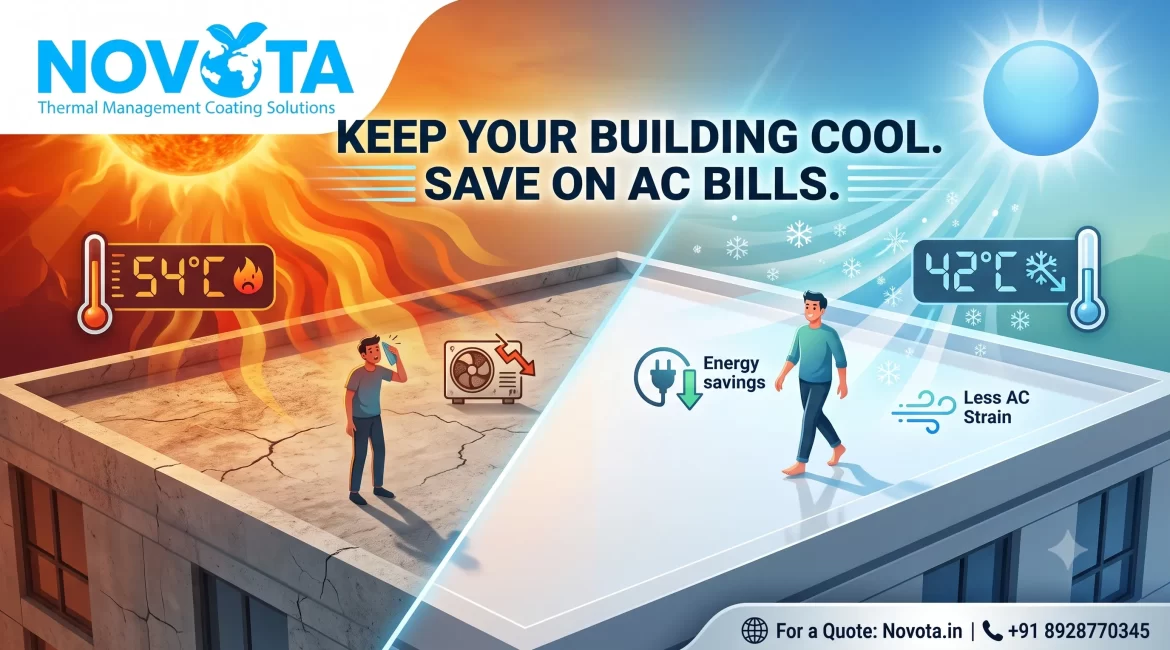
How to Keep Your Building Cool & Save on AC Bills. Get your space summer-ready today! 👉 Visit Novota.in or call +91 8928770345 get your quote.
Delhi is blazing at over 40°C! 🥵 But look at this uncoated floor: a scorching 54°C.
Now watch this… with Sunsheetal an advanced thermal barrier coating, it’s just 42°C! ❄️📉
It actually keeps your building super cool.
Soft on your feet 👣
Huge energy savings ⚡
Less strain on your AC! 🌬️
Don’t let your roof bake this summer. Beat the heat and protect your home with Sunsheetal.
Get your space summer-ready today!
👉 Visit Novota.in or call +91 8928770345 right now to get your quote.
India’s Hottest Cities Need Smarter Heat Protection
When temperatures climb beyond 40°C, cities such as Sri Ganganagar, Phalodi, Churu, Bikaner, Jaisalmer, Jodhpur, Barmer and Jaipur can experience intense summer heat that turns exposed roofs and floors into heat-absorbing surfaces. Delhi and New Delhi can also face scorching summer conditions, while Agra, Jhansi, Prayagraj, Kanpur, Lucknow and Patna experience severe heat during peak summer. Imagine stepping onto an unprotected rooftop after hours of direct sunlight—the surface can become dramatically hotter than the surrounding air. This is where Sunsheetal by Novota can help. Its heat-reflective technology is designed to reflect solar radiation and reduce heat absorption, helping exposed surfaces stay significantly cooler. Whether it is a home, commercial building, warehouse or industrial facility, Sunsheetal can become an important part of a practical summer heat-management strategy. Don’t let India’s summer heat turn your roof into a heat reservoir—explore Sunsheetal at Novota.in or call +91 8928770345 for your requirement.
Heat Reflective Protection for Hot Industrial Cities
The heat challenge is not limited to North India. Nagpur, Chandrapur, Akola, Wardha and Amravati in Maharashtra can experience intense summer temperatures, while Ahmedabad, Gandhinagar, Surendranagar, Rajkot and Vadodara in Gujarat face prolonged periods of high heat. Further south, Hyderabad, Nizamabad, Warangal, Vijayawada and Guntur can experience substantial heat exposure, while Raipur and Bilaspur in Chhattisgarh and Bhopal, Gwalior and Indore in Madhya Pradesh also face demanding summer conditions. For factories, warehouses, industrial sheds and commercial buildings in these cities, reducing solar heat absorption can be an important component of thermal management. Sunsheetal’s heat-reflective technology helps reflect solar radiation from exposed surfaces, potentially reducing the amount of heat transferred into the building. The result can be a cooler surface, improved indoor comfort and reduced cooling load under suitable building conditions. If your roof is baking under the Indian summer sun, don’t simply add more cooling equipment—first consider reducing the heat entering the building. Visit Novota.in or call +91 8928770345 to discuss Sunsheetal for your application.
Beat the Heat Across India’s Hottest Urban and Industrial Regions
From Delhi and New Delhi to Ahmedabad, Gandhinagar, Surat, Rajkot, Vadodara, Jaipur, Bikaner, Jodhpur, Nagpur, Hyderabad, Vijayawada, Guntur, Raipur, Bilaspur, Bhopal, Gwalior, Indore, Agra, Jhansi, Prayagraj, Kanpur, Lucknow and Patna, India’s hottest regions need practical approaches to managing solar heat. Even Mumbai and Thane, despite having a different coastal climate, can experience uncomfortable heat and significant solar exposure on large building surfaces. Bengaluru and Chennai also present different thermal conditions but can benefit from appropriate building heat-management strategies where solar gain contributes to indoor heat. Sunsheetal is designed for applications where reducing solar heat absorption is the objective. Think of the difference: Delhi’s outdoor air may cross 40°C, while an exposed uncoated surface can become considerably hotter under direct sunlight. With Sunsheetal, the surface can reflect a greater proportion of solar radiation instead of absorbing it. The benefits can include a cooler-touching surface, reduced solar heat gain, improved thermal comfort and potentially less strain on cooling systems. Don’t let your roof bake this summer—make your building summer-ready with Sunsheetal by Novota. 👉 Visit Novota.in or call +91 8928770345 today for a quote.
Frequently Asked Questions About SunSheetal Heat Reflective Coating
1. What is SunSheetal?
SunSheetal is an advanced, water-based, single-component heat reflective coating manufactured by Novota Thermotech Pvt. Ltd. It is engineered to manage solar heat gain by combining high solar reflectance with high thermal emittance. The coating incorporates reflective and emissive ceramic ingredients that help reflect incoming solar radiation and release absorbed heat back toward the atmosphere.
SunSheetal is designed for applications where reducing heat absorption from exposed surfaces is important, including roofs, industrial sheds, warehouses, exterior walls, electrical enclosures, tanks, pipelines and other suitable surfaces.
How to Keep Your Building Cool & Save on AC Bills
2. How does SunSheetal heat reflective coating work?
SunSheetal works through two important thermal mechanisms: solar reflectance and thermal emittance.
Its reported solar reflectance is 0.855, meaning approximately 85.5% of incoming solar energy is reflected under the specified test conditions. Its reported solar emittance is 0.882, allowing absorbed thermal energy to be emitted as longwave infrared radiation.
Together, these properties help reduce the amount of solar energy retained by the coated surface.
How to Keep Your Building Cool & Save on AC Bills
3. What is the Solar Reflective Index of SunSheetal?
SunSheetal has a reported Solar Reflective Index, or SRI, of 108 based on the supplied certification information.
SRI is a combined performance metric that considers solar reflectance and thermal emittance. It is commonly used in cool-roof evaluation to compare the thermal behaviour of roof surfaces.
For architects, consultants and green-building professionals, SRI can be an important parameter when evaluating reflective roof coating technologies.
How to Keep Your Building Cool & Save on AC Bills
4. What does an SRI of 108 mean?
An SRI of 108 indicates very high solar-reflective and thermal-emissive performance under the applicable test methodology.
SRI should not, however, be interpreted as a direct prediction of indoor temperature reduction. Actual building performance depends on roof construction, insulation, climate, solar exposure, ventilation, internal heat generation and cooling-system operation.
The SRI is best understood as a standardized material-performance indicator rather than a guaranteed indoor temperature value.
How to Keep Your Building Cool & Save on AC Bills
5. How much solar radiation does SunSheetal reflect?
According to the supplied technical information, SunSheetal has a solar reflectance of 0.855, or approximately 85.5%.
The coating is designed to reflect energy across the solar spectrum rather than relying only on visible whiteness. This is important because a significant portion of solar energy is present in the near-infrared region.
How to Keep Your Building Cool & Save on AC Bills
6. Does SunSheetal reflect infrared radiation?
Yes. SunSheetal is designed to reflect solar radiation including infrared wavelengths. The supplied product information states that the coating reflects approximately 90% of infrared and ultraviolet radiation.
This spectral behaviour is an important distinction between an engineered heat reflective coating and an ordinary white decorative paint.
How to Keep Your Building Cool & Save on AC Bills
7. How is SunSheetal different from ordinary white paint?
A surface appearing white does not automatically mean that it has the same thermal performance as an engineered cool-roof coating.
SunSheetal is formulated specifically around solar reflectance and thermal emittance. Its reported solar reflectance is 0.855, thermal emittance is 0.882 and SRI is 108.
Therefore, the product should be evaluated using measurable thermal-performance parameters rather than colour alone.
How to Keep Your Building Cool & Save on AC Bills
8. How much can SunSheetal reduce surface temperature?
The supplied field-test data shows surface temperature reductions ranging from approximately 17.5°C to 29.1°C depending on the substrate.
For example, the reported test data recorded a reduction of approximately 29.1°C on smooth bitumen and approximately 21°C on an unpainted metal roof.
Actual results will vary according to weather, solar intensity, substrate, roof construction, coating condition, application quality and measurement methodology.
How to Keep Your Building Cool & Save on AC Bills
9. What was the highest temperature reduction recorded in the supplied SunSheetal field test?
The highest reduction in the supplied field-test data was approximately 29.1°C on smooth bitumen.
The reported test was conducted in Jamshedpur at 2:00 PM with an ambient temperature of 37.6°C.
The results should be considered field-test observations for the specified conditions and substrates rather than a universal guaranteed temperature reduction.
How to Keep Your Building Cool & Save on AC Bills
10. Can SunSheetal reduce indoor temperature?
SunSheetal is designed to reduce solar heat absorption at the exposed surface, which can reduce heat transfer into a building.
The actual indoor temperature improvement depends on factors such as roof construction, insulation, ventilation, occupancy, internal heat sources, air-conditioning and local weather conditions.
Therefore, SunSheetal should be considered part of an integrated building thermal-management strategy.
How to Keep Your Building Cool & Save on AC Bills
11. Can SunSheetal reduce air-conditioning costs?
Reducing solar heat gain can reduce the cooling load of a building under appropriate conditions. Consequently, SunSheetal may help reduce the energy required by air-conditioning systems.
The actual savings depend on building design, roof area, climate, HVAC efficiency, operating hours and internal heat generation.
For this reason, energy savings should ideally be evaluated against the site’s existing baseline rather than assuming one fixed percentage for every building.
How to Keep Your Building Cool & Save on AC Bills
12. How much energy can SunSheetal save?
The supplied product information indicates potential reductions in air-conditioning energy consumption depending on building type and climate.
However, energy savings are project-specific. A warehouse with a large exposed metal roof may have a different result from an insulated commercial building.
A technical assessment or before-and-after energy analysis provides a more reliable estimate.
How to Keep Your Building Cool & Save on AC Bills
13. Can SunSheetal reduce HVAC load?
Yes, reducing solar heat absorption can potentially reduce the cooling load imposed on HVAC systems.
When the roof absorbs less solar energy, less heat is transferred into the building. This can reduce the amount of heat that the cooling system needs to remove.
The effect is generally more relevant where the roof is a significant contributor to the building’s cooling load.
14. What surfaces can SunSheetal be applied to?
According to the supplied product information, SunSheetal is suitable for several common building and industrial surfaces, including:
- RCC and concrete
- Asbestos sheets
- GI sheets
- Galvalume
- Aluminium
- Powder-coated metal
- Polycarbonate
- Fibreglass
- Modified bitumen
- Modified asphalt
Surface condition and coating compatibility should always be assessed before application.
How to Keep Your Building Cool & Save on AC Bills
15. Can SunSheetal be applied over powder-coated surfaces?
Yes. The supplied product information specifically states that SunSheetal can bond to pre-coated surfaces, including powder-coated and aluminium-painted surfaces.
Proper cleaning and preparation remain essential for achieving reliable adhesion.
How to Keep Your Building Cool & Save on AC Bills
16. Can SunSheetal be used on metal roofs?
Yes. SunSheetal can be considered for suitable GI, galvalume, aluminium, powder-coated and other compatible metal roofing surfaces.
Metal roofs are particularly relevant to solar heat management because exposed metal surfaces can reach substantially higher temperatures than ambient air under intense sunlight.
How to Keep Your Building Cool & Save on AC Bills
17. Can SunSheetal be applied on concrete roofs?
Yes. Concrete and RCC roofs are among the stated application surfaces.
The concrete should be properly cleaned and repaired before coating. Cracks, gaps, loose material and surface contamination should be addressed before application.
How to Keep Your Building Cool & Save on AC Bills
18. Can SunSheetal be used on industrial sheds and warehouses?
Yes. Industrial sheds and warehouses are important applications because large roof areas can absorb substantial amounts of solar radiation.
Applying a high-reflectance coating to suitable roof surfaces can help reduce solar heat gain and potentially improve indoor thermal comfort and cooling efficiency.
How to Keep Your Building Cool & Save on AC Bills
19. Can SunSheetal be used on electrical enclosures?
Yes. SunSheetal can be used on suitable external surfaces of electrical enclosures and control-panel structures where solar exposure contributes to heat gain.
Reducing external solar heat absorption can help reduce thermal loading on enclosed electrical equipment. The coating should not, however, replace required ventilation, thermal design or equipment-specific cooling systems.
How to Keep Your Building Cool & Save on AC Bills
20. Can SunSheetal be applied to tanks and pipelines?
Yes. The supplied applications include tanks and pipelines.
For tanks and pipelines, thermal management can be important where solar exposure contributes to temperature fluctuations, thermal expansion or evaporation.
The coating system should be selected according to the tank or pipeline substrate, operating conditions and chemical environment.
How to Keep Your Building Cool & Save on AC Bills
21. Is SunSheetal suitable for petrochemical storage tanks?
SunSheetal is listed for petrochemical storage applications. However, petrochemical facilities require particularly careful engineering evaluation because the coating may be exposed to hydrocarbons, chemicals, elevated temperatures and stringent safety requirements.
Compatibility with the substrate, contents, operating environment and applicable plant safety requirements should be confirmed before application.
How to Keep Your Building Cool & Save on AC Bills
22. Can SunSheetal be used on vehicle rooftops?
The supplied product information identifies vehicle rooftops and transport applications among potential applications.
Reflective coating on exposed vehicle roof surfaces can help reduce solar heat absorption. The coating system must be evaluated for adhesion, flexibility, vibration, weather exposure and the specific vehicle substrate before large-scale application.
23. Is SunSheetal suitable for cold storage facilities?
SunSheetal can be considered for suitable external roof surfaces of cold storage facilities where solar heat gain contributes to the refrigeration load.
Reducing external solar heat absorption can potentially reduce the thermal load imposed on the building envelope and refrigeration system.
Actual energy savings depend on insulation, refrigeration efficiency, building design and operating conditions.
24. Is SunSheetal water-based?
Yes. SunSheetal is described as a water-based coating.
This formulation can provide application and environmental advantages compared with many solvent-heavy coating systems, subject to the complete product specification and application environment.
25. Is SunSheetal a single-component coating?
Yes. SunSheetal is supplied as a single-component, ready-to-use coating according to the provided technical information.
This can simplify handling and application because there is no separate resin-and-hardener mixing step.
26. Does SunSheetal contain lead or chromate?
According to the supplied product specifications, SunSheetal is lead-free and chromate-free.
This is particularly relevant for facilities where material safety and environmental considerations are important.
27. What is the VOC content of SunSheetal?
The supplied technical data specifies very low VOC content of under 50 g/L.
Low-VOC coating technology can be advantageous in applications where reduced volatile organic compound emissions are desired.
28. Is SunSheetal non-toxic?
The supplied product information describes SunSheetal as non-toxic, lead-free and chromate-free.
As with any coating product, users should follow the manufacturer’s Safety Data Sheet, application instructions, ventilation requirements and recommended personal protective equipment.
29. How many coats of SunSheetal are required?
The specified application consists of two coats.
The second coat should be applied after the recommended drying interval, with the second coat applied perpendicular to the first coat to achieve appropriate coverage.
30. What is the coverage of SunSheetal?
The supplied technical specification states approximately 50 square feet, or 4.65 square metres, per kilogram for two coats on a smooth surface.
Actual coverage can vary depending on substrate texture, porosity, application method, surface condition and application technique.
31. What is the dry film thickness of SunSheetal?
The supplied specification indicates a total dry film thickness of approximately 100 microns for two coats.
Maintaining the specified coating thickness is important for achieving consistent product performance.
32. How long should I wait between SunSheetal coats?
The supplied application instructions recommend a minimum interval of 6 hours between the first and second coat.
Environmental conditions such as temperature and humidity can influence drying behaviour.
33. How long does SunSheetal take to fully cure?
The supplied information states that full curing occurs in approximately 48 hours at 30°C.
The actual curing time can vary according to environmental conditions and substrate conditions.
34. Can SunSheetal be diluted with water?
No. The supplied application instructions specifically state that SunSheetal should not be diluted and should be used as supplied.
35. Can another coating be applied over SunSheetal?
SunSheetal is specified as the final outermost coat. It should not be overcoated unless Novota’s technical team specifically recommends a compatible system for the particular application.
36. Can SunSheetal be applied during rain?
No. The application should not be carried out during rain or under unsuitable wet conditions.
The coated surface should also be protected from water exposure for the specified period following application.
37. What is the recommended application temperature for SunSheetal?
The supplied application range is 8°C to 60°C, with approximately 16°C to 34°C identified as the recommended range.
Application conditions should be checked before starting the coating work.
38. How long does SunSheetal last?
The supplied product information specifies a certified product life of approximately 5 years.
Durability depends on substrate preparation, application quality, weather exposure, surface contamination, maintenance and actual environmental conditions.
39. Is SunSheetal resistant to UV exposure?
SunSheetal is designed for outdoor solar exposure and the supplied durability information includes accelerated ageing and UV-related performance claims.
Outdoor coating performance should nevertheless be monitored because environmental exposure varies significantly between locations.
40. Is SunSheetal resistant to algae, fungi and moss?
The supplied product information states excellent resistance to fungi, algae and moss.
This characteristic can be useful for exterior roof applications exposed to moisture and biological growth.
41. What is the abrasion resistance of SunSheetal?
The supplied technical data specifies abrasion resistance of 6000 cycles.
Abrasion performance is an important consideration where coated surfaces may experience mechanical contact or maintenance activity.
42. Does SunSheetal absorb water?
The supplied product information states NIL water absorption.
Actual performance should be interpreted according to the relevant test method and product certification documentation.
43. Is SunSheetal suitable for green buildings?
Yes. The supplied product information identifies SunSheetal as a green-building-compliant heat reflective coating and states compliance with relevant LEED, Energy Star and IGBC cool-roof requirements.
Architects and sustainability consultants should verify the current certification documentation and project-specific credit requirements before making certification claims.
44. Can SunSheetal help reduce the urban heat island effect?
Reflective roof surfaces can contribute to cool-roof strategies that reduce solar heat absorption.
At building and city scale, widespread use of high-reflectance surfaces can form part of broader strategies for addressing heat-island effects.
The actual urban impact depends on the scale and design of implementation.
45. Does SunSheetal replace roof insulation?
Not necessarily.
Reflective coatings and insulation address heat transfer through different mechanisms. SunSheetal reduces solar heat absorption at the surface, while insulation primarily reduces conductive heat transfer.
In some buildings, both technologies can work together as part of a comprehensive thermal-management strategy.
46. Is SunSheetal a waterproofing coating?
SunSheetal is primarily a heat-reflective coating, not a substitute for a dedicated waterproofing system.
Roof cracks, joints, gaps and structural defects should be repaired using suitable materials before application.
Where waterproofing is required, the complete roof system should be designed accordingly.
47. Can SunSheetal be used on an old roof?
Potentially, yes, provided the existing roof is structurally sound and the substrate is suitable for coating.
Old roofs may require extensive cleaning, removal of loose coatings, corrosion treatment, crack repair and other preparation before application.
48. Can SunSheetal be applied directly over rust?
Loose rust and surface corrosion should not simply be painted over.
The surface must be appropriately prepared according to the coating system and substrate condition. Serious corrosion may require repair or additional protective treatment before SunSheetal is applied.
49. Does SunSheetal work better on dark roofs?
A dark, high-absorptance roof can have substantial solar heat gain. Consequently, converting such a surface into a high-reflectance surface can produce a significant change in solar absorption.
The supplied field-test data showed a particularly large temperature reduction on smooth bitumen and tar felt.
50. Why is SunSheetal described as a heat-reducing paint?
SunSheetal reduces heat absorption primarily by reflecting incoming solar radiation and managing residual absorbed heat through thermal emittance.
The term “heat-reducing paint” therefore describes its intended functional role: reducing solar heat gain at the coated surface.
51. Is SunSheetal suitable for homes?
Yes. Suitable residential roofs and terraces can benefit from reflective roof coating technology, particularly in buildings exposed to intense summer sunlight.
The expected result depends on roof construction, insulation, ventilation and local climate.
52. Can SunSheetal be used on exterior walls?
The supplied product information identifies exterior walls among its applications.
For walls, solar exposure, substrate condition and architectural requirements should be evaluated before application.
53. Can SunSheetal reduce roof surface temperature without air-conditioning?
Yes. The coating’s thermal mechanism does not depend on air-conditioning.
It reduces solar absorption at the exposed surface. This can help maintain a lower surface temperature even before considering the effect of mechanical cooling inside the building.
54. Can SunSheetal help protect roofing materials from heat-related degradation?
Reducing surface temperature and thermal cycling can potentially reduce thermal stress on suitable roofing substrates.
The degree of protection depends on the material, environmental exposure and actual temperature cycle.
55. Is SunSheetal suitable for industrial applications?
Yes. Its stated applications include industrial sheds, warehouses, electrical enclosures, tanks, pipelines, petrochemical storage tanks and other suitable industrial surfaces.
Industrial applications should be evaluated based on substrate, temperature, chemical exposure, maintenance requirements and safety conditions.
56. Is SunSheetal suitable for high-temperature industrial equipment?
SunSheetal has a specified service temperature range after curing. It should therefore not automatically be specified for extreme-temperature process equipment simply because it is a heat-reflective coating.
For applications involving temperatures beyond SunSheetal’s intended service conditions, Novota provides other functional thermal coating technologies, including HeatXperse, subject to technical evaluation.
57. What is the difference between SunSheetal and a heat resistant coating?
SunSheetal is primarily a heat-reflective coating designed to reduce solar heat absorption.
A heat resistant coating is primarily designed to withstand elevated operating temperatures.
They solve different engineering problems and should not be treated as interchangeable.
58. What is the difference between heat reflective and heat insulating coatings?
Heat reflective coatings reduce solar energy absorption at the surface.
Heat insulating materials reduce heat transfer through a material by providing thermal resistance.
In some applications, reflective and insulating technologies can be combined to improve overall thermal performance.
59. Can SunSheetal reduce carbon emissions?
If the coating reduces cooling energy consumption, it can potentially contribute to lower indirect carbon emissions associated with electricity use.
The actual carbon reduction depends on the amount of energy saved and the emissions intensity of the electricity used by the facility.
60. How can I get a technical consultation for SunSheetal?
Businesses, architects, facility managers, contractors and industrial users can contact Novota Thermotech to discuss their application, substrate, roof area and thermal-management requirements.
For technical enquiries and quotations:
Email: info@novota.in
Phone: +91 8928770345 / +91 9320047879
Location: Thane, Maharashtra, India
Novota’s technical team can help determine whether SunSheetal is appropriate for the specific surface and operating environment before a larger coating project is undertaken.
Final Answer: Is SunSheetal the Right Heat Reflective Coating for Your Project?
The answer depends on your heat-management objective.
If your primary problem is solar heat entering through roofs, walls, tanks, industrial sheds, warehouses or other exposed surfaces, SunSheetal can be evaluated as a high-reflectance, high-emittance coating solution.
Its reported SRI of 108, solar reflectance of 0.855, thermal emittance of 0.882 and field-test temperature reductions provide measurable technical parameters for evaluation.
However, successful thermal management involves more than selecting a coating. Substrate condition, application quality, roof construction, insulation, ventilation, climate and building operation all influence the final result.
For this reason, the most effective approach is to evaluate SunSheetal according to your actual application rather than relying on generic claims.
If you are looking to reduce solar heat gain, improve thermal comfort and potentially reduce cooling requirements, contact Novota Thermotech for a technical discussion and project-specific recommendation.
SunSheetal Heat Reflective Coating
Solar Reflective Coating
Roof Heat Reflective Coating
AC bill
Subscribe our Channel for regular updates.
- How Novota’s Functional Coatings are Revolutionising Furnace Efficiency
- What is a Thermal Conductive Coating? Industrial Applications & Properties
- Why Every Energy Generator Industry Should Consider emiSEAL
- Understanding Heat Reflective Coatings: Benefits, Uses & How They Work
- Does Solar Reflective Paint Work? Here’s What Science Says
- Emissivity Explained: The Key to Effective Thermal Management in Coatings
- Why Tempseal is Essential for Iron and Steel Processing
- How Novota’s Advanced Coatings Are Shaping the Future of the Automotive Industry
- Simplifying the Science Behind High Emissivity Coatings
- Tempseal: A Key to Safety and Efficiency in Petrochemical Operations
- The Importance of Surface Preparation Before Applying Industrial Coatings
- How Heat Reflective Coatings Reduce Energy Expenses and Improve Employee Well-Being
- Heat Dissipation Coating to Reduce the Air Pressure in Automobile Tires
- How can heat-reflective paint improve energy efficiency in buildings?
- A Guide for Choosing the Right Industrial Coating for Heat Management and Performance
- Heat dissipation coating to effectively manage thermal energy for a global leader in the wire and cable industry
- The Future of Industrial Coatings: Trends and Innovations to Watch
- The Economic Benefits of Investing in High-Performance Industrial Coatings
- Top 7 Benefits of Using Heat Reflective Paint
- Thermal Emissivity Paint
- How to keep terrace cool
- Energy Saving Paint
- Heat Reflective Paint