

Discover how heat reflective coatings reduce factory cooling expenses & improve worker productivity. Contact us today! Mail us info@novota.in
Are you already feeling the need to invest in more cooling equipment for your factory, even before May arrives? And yet, your electricity bills are already soaring. What’s even worse is that despite all this, your employees are still battling discomfort despite the cooler running nonstop.
But here’s the thing – you don’t need to spend on more cooling equipment. All you need is a heat-reflective paint. Keep reading to learn more.
Why have energy expenses soared?
The soaring temperature is no secret. Every new day feels hotter than yesterday. As temperatures exceed 40°c in many states, industrial-grade cooling systems operate longer, drawing more power. Overall, India’s energy demand is rising fast. By June 2025, the demand is expected to reach 273 GW– more than the entire power capacity of Germany and the UK combined.
In heat-intensive industries, the situation is worse. The heat generated by heavy machinery leads to increased energy consumption, as cooling systems work overtime to maintain a comfortable indoor environment.
Besides the soaring expense of maintaining an optimum temperature, the increasing temperature has also affected the workers.
How Heat Affects Your Factory Workers?
Burnout, literally! Factory workers are most affected by the increasing temperatures. Extreme heat, exacerbated by climate change, has been costing lives worldwide. It’s not just the blazing summer outside; the heat from heavy machines adds to the stress inside factories.

Workers often face:
- Fatigue and slower work
- More breaks and less output
- Reduced focus and higher risk of errors
- Dehydration, cramps and dizziness
- Heat exhaustion or heatstroke
- Discomfort and stress
How Can Heat-Reflective Coatings Help?
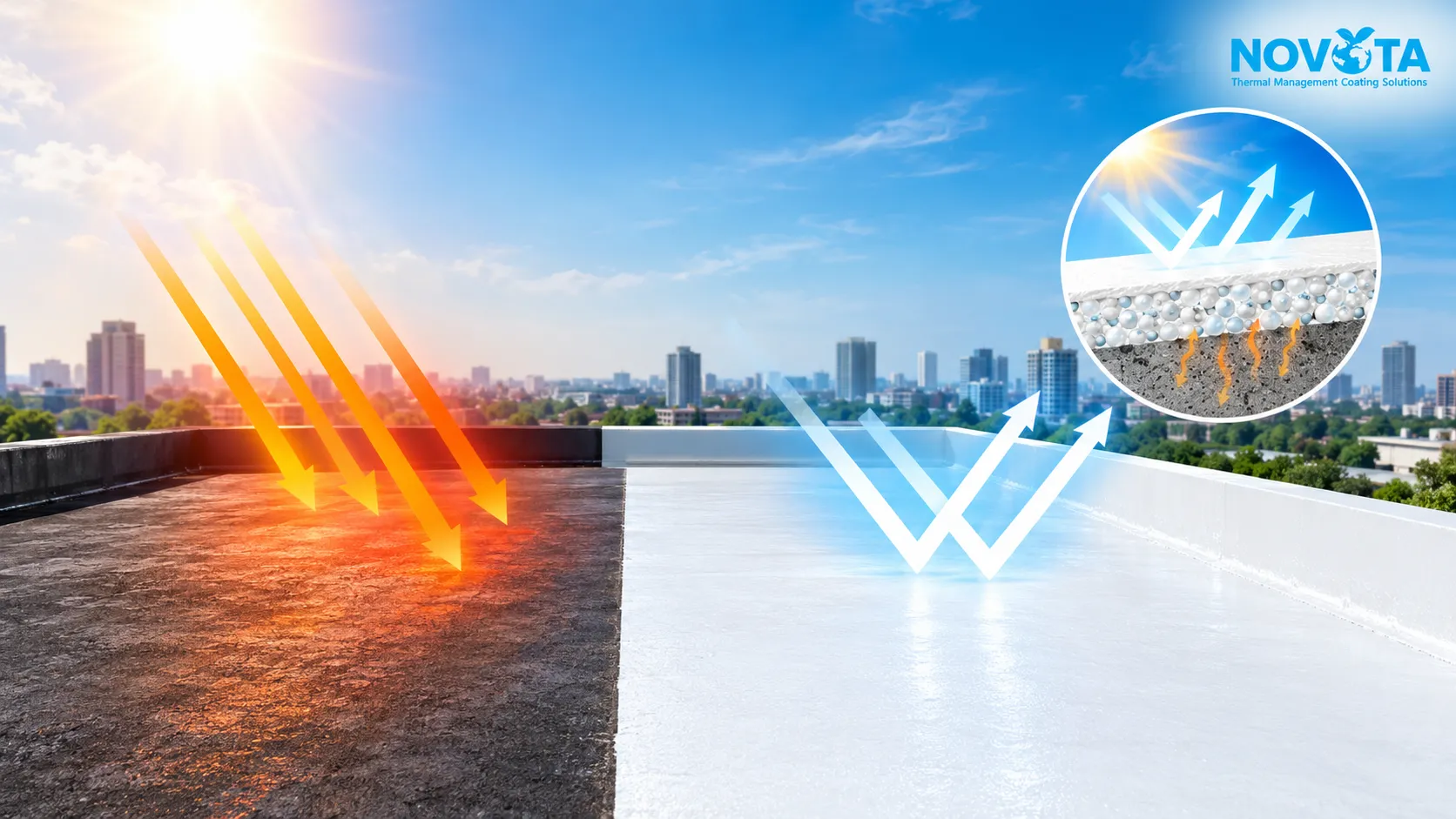
Heat-reflective coatings are innovative paints designed to reflect sunlight. These heat control roof paint blocks out a significant portion of the sun’s infrared radiation, keeping the surface cooler.
How Do Heat-Reflective Coatings Work?
1. Reflective Properties
These coatings use heat-reflective technology to bounce back the sun’s heat instead of absorbing it. Thus, they reduce the amount of heat that enters the building.
2. Lower Indoor Temperature:
When less heat penetrates the structure, the factory’s interior remains cooler. This regulates the temperature management systems without additional strain.
Watch this video for a better explanation
Benefits of Heat Reflective Paint for Energy Costs:
- Reduced Cooling Needs: Lowering the internal temperature means the cooling systems don’t have to work as hard. The result is a significant reduction in energy bills.
- Less Strain on Equipment: The temperature management systems aren’t running at full capacity, and the interiors remain cooler. This reduces the risk of system damage, saving money on repairs and replacements.
- Sustainability: With energy consumption dropping, factories also reduce their carbon footprint. This is essential for companies trying to reduce their environmental impact.
Read More: How can heat-reflective paint improve energy efficiency in buildings?
Benefits of Heat Reflective Paint for Your Employees:
- Better Working Conditions: A lower indoor temperature creates a more comfortable working environment.
- Health and Safety: Reducing indoor heat reduces the risk of heat-related illnesses.
- Increased Productivity: A cooler environment helps employees focus and work more efficiently.
- Compliance with Health Regulations: Industries are required to maintain certain temperature levels to comply with workplace health and safety regulations. They meet these standards as energy-efficient coatings without additional air conditioning or cooling costs.
Read More: Top 7 Benefits of Using Heat Reflective Paint
Conclusion:
While heat-reflective coatings may be an added expense, the long-term benefits outweigh the costs. Heat-reflective paints are a smart and sustainable solution for factories seeking to reduce energy costs while improving the working environment.
At Novota Themrotech, a manufacturer of innovative coatings for heat-sensitive environments, we have researched creating a unique formulation using our heat-reflective technology, Sunsheetal.
Novota is India’s only manufacturer and supplier of heat-reflective paint (Sunsheetal) with the highest solar reflective index – 108. This index measures a surface’s ability to reflect solar heat, with higher values indicating better heat reflection.
While heat-reflective paint is ideal for blocking solar heat, there are other heat control coatings built to improve performance in heat-intensive operations. Read the guide on heat management coatings to choose the right one.
Are you ready to reduce energy expenses and improve your factory’s environment? Contact us today.
Heat Reflective Coatings for Industrial Roofs and Factories
When the objective is to reduce heat entering an industrial building, the roof is often the first surface that deserves attention. Large factory roofs, warehouses, production sheds and commercial structures remain exposed to direct solar radiation for several hours every day. Once the roof absorbs that solar energy, a portion of the heat is transferred through the building envelope and increases the indoor thermal load.
This is where heat reflective coatings can become an important part of a practical heat-management strategy.
A properly engineered heat reflective coating does not work by simply making a roof look white. Its purpose is functional: to reflect a greater proportion of incoming solar radiation and reduce the amount of solar energy converted into heat at the surface.
Novota Thermotech develops functional coating technologies around the principles of solar reflectivity, thermal emissivity and surface modification. Its heat-reflective technology is designed for applications including roofs, exterior walls, factories, warehouses and other surfaces exposed to significant sunlight.
Heat Reflective Coatings vs Conventional Roof Paint
It is important to understand that ordinary roof paint and heat reflective coatings are not necessarily the same thing.
Conventional paint is generally selected for appearance, corrosion protection, waterproofing or basic surface protection. A heat reflective coating, on the other hand, is formulated with thermal performance as one of its primary objectives.
The effectiveness of a reflective coating is influenced by factors such as:
- Solar reflectance
- Thermal emittance
- Solar Reflectance Index
- Coating formulation
- Surface preparation
- Coating thickness
- Substrate material
- Roof orientation
- Local climate
- Application quality
- Condition of the existing roof
This distinction is particularly important for industrial facilities because the objective should not simply be to apply a coating. The objective should be to identify the source of heat gain, select an appropriate coating system and apply it correctly.
How Heat Reflective Coatings Reduce Solar Heat Gain
Solar radiation reaches a roof in several wavelength ranges, including visible, infrared and ultraviolet radiation.
A conventional roof can absorb a considerable portion of this radiation and convert it into thermal energy. The roof surface then becomes significantly hotter than the surrounding air.
A high-performance heat reflective coating is designed to alter this interaction with solar radiation.
Instead of allowing as much solar energy to be absorbed, the reflective surface sends a larger proportion of the incoming radiation away from the building.
The basic thermal pathway can therefore be understood as:
Sunlight → Roof surface → Solar reflection → Reduced heat absorption → Lower heat transfer → Lower indoor thermal load
This does not mean that a reflective coating eliminates heat completely. Rather, it reduces one important source of heat gain: solar radiation absorbed by the exposed surface.
That distinction is important when evaluating industrial energy-saving projects.
Understanding Solar Reflectance and Thermal Emittance
Two technical properties are particularly important when evaluating heat reflective coatings: solar reflectance and thermal emittance.
Solar Reflectance
Solar reflectance describes how much incoming solar energy is reflected by a surface.
A higher solar reflectance generally means that less solar radiation is absorbed by the surface.
This is one reason high-albedo surfaces are important in cool-roof technologies.
Thermal Emittance
Thermal emittance describes a surface’s ability to emit absorbed thermal energy as infrared radiation.
A coating with suitable thermal emissivity can help release absorbed heat rather than retaining it at the surface.
Solar Reflectance Index
The Solar Reflectance Index, commonly called SRI, combines solar reflectance and thermal emittance into a single indicator used to compare the thermal behaviour of surfaces.
Higher SRI values generally indicate better cool-roof performance under standardized conditions.
For this reason, industrial buyers should look beyond statements such as “heat proof paint” or “cool roof paint” and ask for meaningful technical performance information.
Why Heat Reflective Coatings Matter for Indian Industrial Buildings
India’s industrial landscape includes thousands of factories, warehouses, logistics facilities and processing units with large exposed roofs.
Many of these structures use metal sheets, concrete slabs or other materials that receive intense solar exposure.
During peak summer conditions, the roof can become one of the major contributors to indoor heat gain.
This creates a chain reaction.
Higher roof temperature can contribute to higher indoor temperatures.
Higher indoor temperatures can increase dependence on fans, evaporative coolers, air-conditioning and other cooling systems.
Higher cooling demand can increase electricity consumption.
Higher electricity consumption increases operating costs.
And when workers are exposed to excessive heat for extended periods, comfort, concentration and productivity can also be affected.
This is why heat management should not always begin with buying another cooling machine.
Sometimes the more effective starting point is to reduce the amount of heat entering the building in the first place.
Heat Reflective Coatings for Factory Roofs
Factory roofs are among the most practical applications for heat reflective coatings.
A large industrial roof represents a substantial exposed surface area. Even a moderate improvement in solar heat reflection across that area can influence the thermal environment beneath the roof.
Typical applications may include:
- Manufacturing plant roofs
- Industrial sheds
- Warehouse roofs
- Logistics centres
- Distribution facilities
- Commercial building roofs
- Concrete terraces
- Metal roofing systems
- Factory exterior walls
- Storage structures
Novota identifies warehouses, factories, roofs and exterior walls among the applications for its heat-reflective technology.
Heat Reflective Coatings for Metal Roofs
Metal roofs are widely used in industrial construction because they are lightweight, economical and comparatively fast to install.
However, exposed metal roofing can become extremely hot under direct sunlight.
A suitable reflective coating system can be considered as part of a broader thermal-management strategy for these roofs.
Before application, the existing roof should be assessed for:
- Rust or corrosion
- Loose coatings
- Dust accumulation
- Oil and grease contamination
- Surface oxidation
- Existing waterproofing layers
- Loose fasteners
- Damaged sheets
- Water stagnation
- Joints and overlaps
The coating cannot compensate for a structurally damaged roof.
Surface preparation therefore remains an essential part of successful heat reflective coating application.
Heat Reflective Coatings for Concrete Roofs
Concrete roofs and terraces also absorb solar energy throughout the day.
In buildings with occupied areas directly below the roof, this absorbed heat can contribute to indoor discomfort.
Applying a suitable reflective coating can help reduce solar heat absorption at the exposed surface.
The correct preparation depends on the condition of the concrete.
New concrete, aged concrete, previously painted concrete and waterproofed concrete may each require different preparation approaches.
For this reason, coating selection should be based on the actual substrate rather than simply choosing a product based on colour.
Heat Reflective Coatings for Warehouses
Warehouses often have enormous roof areas and large internal volumes.
Although the internal air volume may be high, workers, stored materials, equipment and operations can still be affected by excessive heat.
In logistics and warehousing environments, the thermal challenge can become particularly noticeable when:
- Roof areas are extensive
- Natural ventilation is limited
- Loading bays remain open
- Workers spend long periods inside
- Stored materials are temperature-sensitive
- Cooling systems are already operating at high capacity
Heat reflective coatings can therefore become one component of a broader warehouse heat-management plan.
The objective is not necessarily to replace every cooling system. Instead, the objective is to reduce avoidable solar heat gain before relying entirely on mechanical cooling.
Heat Reflective Coatings and HVAC Energy Consumption
One of the most frequently asked questions is whether reflective roof coatings can reduce HVAC electricity consumption.
The technically accurate answer is that they can reduce cooling demand when solar heat gain is a meaningful contributor to the building’s thermal load.
The actual energy-saving result depends on several variables.
These include:
- Building construction
- Roof area
- Roof material
- Insulation
- Existing indoor temperature
- HVAC efficiency
- Operating hours
- Outdoor climate
- Solar exposure
- Ventilation
- Occupancy
- Internal heat generation
Therefore, no responsible technical assessment should promise one universal percentage of electricity savings for every factory.
The correct approach is to evaluate the building and application conditions first.
Heat Reflective Coatings Are Not a Replacement for Every Cooling System
A common misconception is that applying heat reflective paint means a factory will no longer require air-conditioning or cooling equipment.
That is not necessarily the case.
Heat reflective coatings address solar heat gain.
They do not eliminate heat generated by:
- Furnaces
- Motors
- Compressors
- Boilers
- Production equipment
- Ovens
- Process heating
- Electrical equipment
- People
- Manufacturing operations
This distinction becomes particularly important in heat-intensive industries.
A factory can have a highly reflective roof and still have substantial internal heat generation.
The best thermal-management strategy therefore considers both external and internal sources of heat.
Heat Reflective Coatings as Part of a Complete Heat Management Strategy
A more comprehensive industrial heat-management program can include several layers.
Step 1: Identify the Heat Sources
Determine whether the primary heat problem comes from the roof, walls, machinery, process equipment, ventilation, radiant heat or a combination.
Step 2: Measure the Existing Condition
Record roof surface temperatures, indoor temperatures and operating conditions wherever practical.
Step 3: Evaluate Solar Exposure
Identify surfaces receiving direct sunlight and determine which areas have the greatest potential for heat gain.
Step 4: Select the Correct Coating Technology
Different thermal problems require different coating technologies.
A solar reflective coating is appropriate for solar heat management, while high-emissivity coatings may be more suitable for improving radiative heat transfer in high-temperature process equipment.
Novota’s portfolio includes heat-reflective, high-emissivity, heat-dissipation and other functional coating technologies developed for different thermal applications.
Step 5: Prepare the Surface Correctly
Cleaning, removal of loose material, treatment of corrosion and substrate preparation can directly influence coating performance and durability.
Step 6: Apply According to the Technical Specification
Coating thickness, drying conditions, application method and environmental conditions should follow the relevant technical recommendations.
Step 7: Monitor Performance
After implementation, compare the thermal and operational conditions against the baseline wherever measurement is feasible.
This transforms a coating project from a simple painting exercise into an engineering-led thermal-management project.
Heat Reflective Coatings and Employee Comfort
Industrial heat management is not only about electricity bills.
It is also about people.
When employees work in excessively hot conditions, physical discomfort can become a serious operational issue.
A better thermal environment can contribute to:
- Improved workplace comfort
- Better concentration
- Reduced perception of heat stress
- Better working conditions
- More stable indoor temperatures
- Improved overall workplace experience
However, reflective coatings should be viewed as one component of workplace heat management, not as a substitute for appropriate ventilation, hydration, rest arrangements, personal protective equipment or occupational safety measures.
Heat Reflective Coatings and Sustainability
Energy efficiency and sustainability are increasingly connected.
When a facility requires less cooling energy, it may reduce the electricity associated with maintaining indoor thermal conditions.
This can support broader sustainability objectives.
Heat reflective technology can contribute to:
- Lower cooling demand
- Improved building energy efficiency
- Reduced heat absorption
- Better thermal comfort
- Cool-roof strategies
- Lower operational energy requirements
- Sustainable building initiatives
Novota describes its heat-reflective technology as part of its broader approach to energy efficiency and sustainability, including applications in buildings, warehouses, factories and infrastructure.
Choosing Heat Reflective Coatings: Questions Every Industrial Buyer Should Ask
Before purchasing any heat reflective coating, ask the manufacturer or supplier the following questions.
What is the solar reflectance of the coating?
Solar reflectance is central to understanding how effectively a coating reflects incoming solar radiation.
What is the thermal emittance?
A coating’s ability to release absorbed thermal energy is another important thermal-performance characteristic.
What is the SRI?
Ask for the relevant test information rather than relying only on marketing terminology.
Is the coating suitable for my roof substrate?
Metal, concrete and other substrates can have different preparation and application requirements.
What surface preparation is required?
Poor preparation can compromise adhesion and long-term performance.
What is the recommended dry film thickness?
Application thickness can influence performance and durability.
How should the coating be maintained?
The manufacturer should provide appropriate maintenance recommendations for the application.
Can the coating be used on an existing roof?
In many cases, reflective coatings can be applied to existing structures, subject to substrate condition and compatibility assessment.
Why Technical Expertise Matters in Heat Reflective Coatings
A thermal coating is a functional engineering product.
The right solution depends on the problem.
For example, a factory experiencing severe solar heat gain through its roof may require a heat reflective coating.
A furnace experiencing inefficient radiative heat transfer may require a high-emissivity coating.
A high-temperature component requiring thermal protection may need a heat-resistant coating.
An overhead conductor requiring heat dissipation represents an entirely different thermal challenge.
Treating all of these applications as “heat paint” can lead to the wrong product selection.
This is why Novota’s approach extends beyond simply manufacturing coatings. The company describes its expertise around functional coatings, application engineering, material science and customized solutions for heat-driven applications.
Novota Thermotech: Engineering Heat Management Through Functional Coatings
Novota Thermotech Pvt. Ltd. has developed its expertise around specialty functional coatings and thermal technologies.
The company’s journey in heat management includes work with high emissivity and reflectivity technologies and the development of Sunsheetal, its heat-reflective coating technology. Novota states that its technical approach combines application expertise, collaborative design and testing to address specific customer requirements.
This experience matters because industrial thermal problems rarely have a one-size-fits-all answer.
The same coating may perform differently depending on the substrate, climate, operating environment, surface preparation and application conditions.
A technical consultation therefore becomes valuable before large-scale application.
Is Heat Reflective Coating the Right Solution for Your Factory?
The answer begins with a simple question:
Where is the heat coming from?
If a significant portion of your building’s thermal load originates from solar radiation absorbed by exposed roofs or walls, heat reflective coatings may be an effective intervention to consider.
If the majority of the heat originates from manufacturing equipment, furnaces or process operations, a different thermal technology may be required.
And in many industrial facilities, the most effective approach may involve multiple thermal-management technologies working together.
That is precisely why choosing a coating should begin with an application assessment rather than a product catalogue.
Frequently Asked Questions About Heat Reflective Coatings
What are heat reflective coatings?
Heat reflective coatings are functional coatings designed to reflect a significant portion of incoming solar radiation and reduce heat absorption by exposed surfaces. They are commonly used on roofs, walls and other surfaces exposed to sunlight.
How do heat reflective coatings work?
Heat reflective coatings work primarily by increasing solar reflectance and, depending on the formulation, providing suitable thermal emittance. Less solar energy is absorbed by the coated surface, which can reduce solar heat gain into the building.
Can heat reflective coatings reduce indoor temperature?
They can help reduce indoor heat gain when solar radiation through the roof or exterior envelope is a significant contributor to the building’s thermal load. The actual temperature reduction varies according to building construction, climate, insulation, ventilation and other factors.
Can heat reflective coatings reduce electricity bills?
They can potentially reduce cooling energy consumption because reducing solar heat gain can reduce the cooling load. Actual savings depend on the building, cooling system, operating hours and environmental conditions.
Are heat reflective coatings suitable for factory roofs?
Yes. Factory roofs are one of the important applications for solar-reflective coating technology, particularly where large roof surfaces are exposed to direct sunlight.
Can heat reflective coatings be applied to metal roofs?
They can be suitable for metal roofing systems, subject to proper substrate evaluation, surface preparation and product compatibility.
Can heat reflective coatings be applied to concrete roofs?
Yes. Concrete roofs and terraces can be suitable applications, provided the surface is properly prepared and the selected coating is compatible with the substrate and operating conditions.
What is the difference between heat reflective paint and heat resistant paint?
Heat reflective paint is primarily designed to reflect solar radiation and reduce heat absorption. Heat resistant paint is designed to withstand elevated temperatures without degrading. The two technologies address different thermal problems.
What is Solar Reflectance Index?
Solar Reflectance Index, or SRI, is a calculated measure that combines solar reflectance and thermal emittance to characterize the thermal behaviour of a surface under standardized conditions.
Is a white roof automatically a heat reflective roof?
Not necessarily. Colour alone does not establish the thermal performance of a coating. The formulation, solar reflectance, thermal emittance and other technical properties should be considered.
Do heat reflective coatings work only in summer?
Solar reflection can be beneficial whenever the coated surface receives significant solar radiation. The practical impact, however, depends on climate, building design, operating conditions and the requirement for heating or cooling.
Can heat reflective coatings replace air-conditioning?
Not necessarily. Reflective coatings can reduce solar heat gain, but they do not eliminate internal heat generated by machinery, people or industrial processes. They should be considered as part of an integrated thermal-management strategy.
How long do heat reflective coatings last?
Service life depends on the coating formulation, substrate, surface preparation, application quality, weather exposure and maintenance conditions. The manufacturer should provide application-specific durability information.
Does surface preparation affect heat reflective coating performance?
Yes. Surface preparation is one of the most important factors influencing adhesion, durability and overall coating performance.
Can heat reflective coatings be used on old factory roofs?
Potentially, yes. Existing roofs should first be inspected for corrosion, contamination, loose material, structural damage, existing coatings and other conditions that could affect application.
Are heat reflective coatings environmentally beneficial?
They can support energy-efficiency and sustainability objectives by reducing solar heat absorption and potentially lowering cooling energy demand. The overall environmental benefit depends on the building and energy system.
Can heat reflective coatings be customized for industrial applications?
Functional coating technologies can be developed or selected according to application requirements such as substrate, temperature, environment and desired thermal performance. Novota states that it develops customized functional coating solutions for specific industrial requirements.
How do I choose the right heat reflective coating?
Start by identifying the heat source, substrate, operating environment, roof condition, required performance and application method. Then evaluate technical data such as solar reflectance, thermal emittance and SRI along with compatibility and durability requirements.
Why should I consult Novota Thermotech before selecting a heat reflective coating?
Because the correct thermal coating depends on the application. Novota Thermotech specializes in functional thermal coatings and works across heat-reflective, high-emissivity, heat-dissipation and other thermal-management technologies. Its technical approach includes understanding application requirements and developing suitable coating solutions.
Final Takeaway: Treat Heat as an Engineering Problem
The question should not simply be, “Which paint should I buy?”
The better question is:
“How can I control the heat entering my facility most efficiently?”
Heat reflective coatings can be an important answer when solar radiation is a major source of heat gain.
They can help transform an exposed roof from a major solar absorber into a more thermally efficient surface. When integrated correctly with insulation, ventilation, cooling systems, shading and other heat-management measures, reflective coating technology can become part of a larger strategy for improving thermal comfort and energy efficiency.
At Novota Thermotech, the focus is not simply on selling paint. It is on developing functional coating technologies that solve real thermal problems.
From heat reflective coatings for buildings and industrial roofs to high-emissivity coatings for high-temperature applications, Novota’s portfolio is built around one fundamental objective:
Maximize efficiency. Minimize unnecessary energy loss. Improve thermal performance.
If your factory, warehouse, commercial building or industrial facility is struggling with excessive solar heat, rising cooling requirements or uncomfortable indoor conditions, the first step is to understand the heat source and evaluate the right thermal solution.
Talk to the Novota Thermotech technical team to discuss your application, substrate, operating conditions and heat-management requirements.
Explore Novota’s heat-reflective technology and discover how a scientifically engineered coating can become part of a smarter approach to industrial heat management.