

Heat Dissipation Coatings to Reduce the Air Pressure in Automobile Tires
Innovative thermal functional coatings by Novota to improve tire safety, reduce overheating, and enhance automotive performance.
The automotive industry seeks innovative solutions for enhancing safety and vehicle efficiency.
This case study explores the use of Heat Dissipation Coating on automobile tires to mitigate the adverse effects of heat buildup.
Problem Statement
This heat causes vigorous vibration of air molecules within the tire. Due to the viscoelastic nature of rubber, this heat buildup can result in tire bulging, increasing pressure, and heightening the risk of blowouts. Such conditions pose significant safety hazards and can lead to serious vehicular accidents.
How Novota Can Help?
Addressing these challenges requires an innovative solution that facilitates faster cooling without affecting the tire’s performance.
When applied to the tire’s rim, Heat Dissipation Coatings reduces overheating by effectively dissipating the heat to the surrounding environment and facilitating faster cooling.
The effectiveness of coating was tested on varied tire surfaces.
- Outer Surface: Increased internal air temperature
- Inner Surface: Heat emitted back into tire
- Brakes: No significant effect
- Tire Rim: Fast heat dissipation
Testing Results
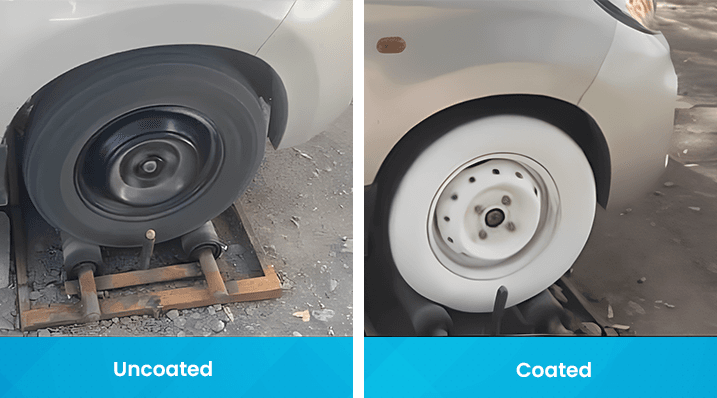
In-house testing was conducted by running the vehicle’s front wheels on fixed cylindrical iron rods to create controlled friction for one hour.
On-field testing: Conducted by operating the automobiles on rough roads in a hot environment for approximately one hour.
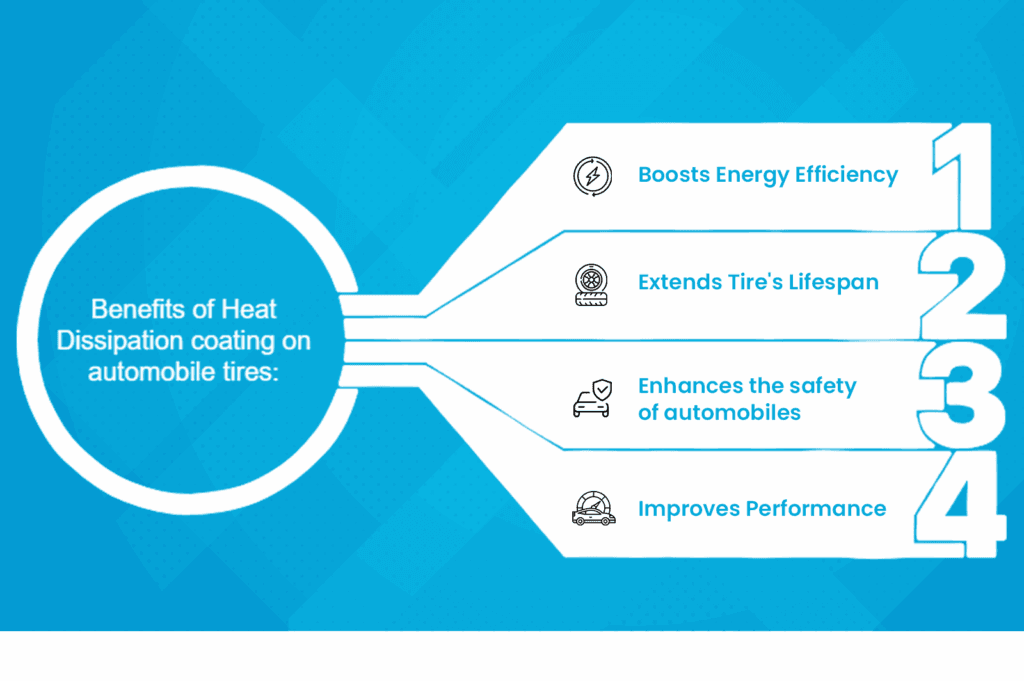
Benefits of Heat Dissipation Coatings on Automobile Tires
Applying the product to the tire’s rim yielded favourable results. After 60 minutes at 80 km/h, the coated tire’s pressure increased by only 2 psi, compared to a 4 psi increase in the uncoated tire.
When the formulation is applied to the rim of the tire
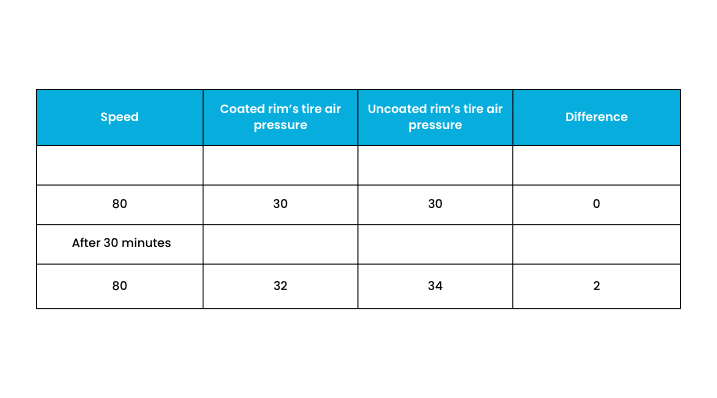
Table 2 (in-house testing)

Comparison Table
| Parameter | Without Coating | With Heat Dissipation Coatings |
|---|---|---|
| Pressure Rise | 4 PSI | 2 PSI |
| Heat Dissipation | Low | High |
| Overheating Risk | Higher | Lower |
| Safety | Moderate | Improved |
Frequently Asked Questions
Heat Dissipation Coating is a thermal functional coating designed to transfer heat away from surfaces faster.
Based on testing, applying the coating to the tire rim delivered the best results.
Yes, reduced heat buildup lowers pressure rise and decreases blowout risk.
The coated tire showed only 2 PSI rise versus 4 PSI in the uncoated tire.
Upgrade Safety & Performance with Advanced Coatings
Are you looking to upgrade the safety and performance of your automotive products?
Tire Heat Management in Modern Automotive Engineering
Why Tire Heat Management Matters
Tire heat management has become a major focus in modern automotive engineering because temperature directly influences safety, handling, durability, and overall vehicle efficiency. During continuous driving, especially at high speeds or under heavy load, tires generate significant heat due to rolling resistance and friction with the road surface.
As a tire rotates, its rubber structure constantly deforms and recovers. This repeated compression creates internal energy loss, which converts into heat. In addition to surface friction, braking force, road roughness, payload weight, and environmental temperature further increase thermal stress.
When heat accumulates faster than it can dissipate, the internal temperature of the tire rises. This causes the air molecules inside the tire to become more energetic, resulting in increased air pressure. Elevated pressure may initially improve rolling efficiency, but beyond a safe threshold it can create serious operational risks.
Poor tire heat management can cause:
- Excessive pressure rise
- Reduced tire grip
- Uneven tread wear
- Increased vibration
- Tire bulging
- Higher blowout probability
In extreme operating conditions such as highways, industrial transportation routes, mining operations, or hot climate regions, heat buildup becomes even more severe. Managing thermal energy effectively is therefore essential for maintaining safe tire performance.
Heat Accumulation Mechanism Inside Tires
Heat generation in tires occurs through multiple mechanisms. The first is road friction. Every contact patch between tire and surface creates micro-level resistance. The second is hysteresis loss, where rubber repeatedly flexes and releases energy as heat. The third is environmental loading, including sunlight, ambient temperature, and nearby engine heat.
Once generated, heat travels through:
- Tire tread
- Sidewall
- Internal air chamber
- Wheel rim
This thermal flow determines how efficiently the system cools down. If heat remains trapped, pressure continues increasing.
The challenge is not preventing heat generation entirely. That is impossible in moving vehicles. The goal is accelerating heat dissipation before dangerous pressure thresholds are reached.
Challenges in Conventional Tire Cooling
Traditional tires rely mostly on passive cooling through air movement and natural heat conduction. While effective under normal conditions, this method becomes insufficient during prolonged or aggressive driving.
Common limitations include:
- Slow heat release from rubber
- Low emissivity of certain wheel surfaces
- Thermal trapping in enclosed geometry
- Delayed cooling after braking
These limitations create opportunities for advanced thermal technologies such as heat dissipation coatings.
Thermal Coating for Tires
What Is Thermal Coating for Tires?
Thermal coating for tires refers to specialized engineered coatings designed to improve heat transfer away from critical tire-related surfaces. These coatings enhance emissivity and accelerate thermal radiation, allowing heat to leave the system more efficiently.
Unlike ordinary paints or protective coatings, thermal coatings are designed with functional performance in mind. Their primary role is thermal management rather than aesthetics.
Such coatings can help:
- Transfer heat faster
- Reduce thermal accumulation
- Stabilize operating temperature
- Improve component longevity
In automotive tire applications, thermal coatings perform best when applied to components that efficiently transfer internal heat outward.
Why Rim Application Works Better
Testing across multiple surfaces reveals an important insight: not every tire-related surface benefits equally from thermal coating.
Applying coating directly to:
- Outer tire surface
- Inner tire surface
- Brakes
did not produce ideal results.
The reason lies in heat flow direction.
Rubber is a viscoelastic material with unique thermal behavior. Applying coating directly to the tire body may interfere with natural thermal balance or reflect heat back into internal air zones.
The rim, however, acts differently.
A tire rim is usually metallic, meaning:
- Better thermal conductivity
- Faster heat transfer
- Larger cooling surface
- Improved emissive potential
This makes the rim an ideal heat escape pathway.
Once coating improves rim emissivity, heat can radiate away much faster.
Thermal Emissivity and Cooling Performance
Emissivity measures how effectively a surface releases thermal energy through radiation.
Higher emissivity means:
- Faster heat release
- Better cooling
- Lower retained temperature
Low-emissivity surfaces retain more heat, causing thermal buildup.
Heat dissipation coating enhances emissivity of the rim surface, converting it into a more efficient thermal radiator.
This reduces retained energy inside the tire assembly.
Tire Pressure Control Through Thermal Management
Relationship Between Temperature and Pressure
Temperature and pressure are directly related inside sealed tire chambers.
As temperature increases:
- Air molecules move faster
- Collision frequency increases
- Internal pressure rises
Even a moderate temperature increase can significantly affect tire pressure.
This is critical because pressure determines:
- Contact patch behavior
- Steering response
- Ride comfort
- Safety margin
Pressure that rises too high creates structural stress on the tire.
Why Pressure Rise Is Dangerous
Many drivers underestimate the dangers of pressure increase during long-distance travel.
Excessive pressure can cause:
- Center tread wear
- Reduced road contact
- Poor braking performance
- Increased impact sensitivity
- Greater rupture risk
When combined with rough roads and hot weather, the danger multiplies.
Pressure spikes may not always be visible externally until failure occurs.
This makes proactive thermal control extremely valuable.
Pressure Reduction Through Heat Dissipation Coating
Testing demonstrated a measurable advantage.
After 60 minutes at 80 km/h:
- Coated tire: 2 PSI increase
- Uncoated tire: 4 PSI increase
This represents a 50% reduction in pressure rise.
That difference is significant in real-world operation.
A lower pressure rise means:
- Reduced thermal stress
- Improved stability
- Lower failure probability
- More predictable performance
Heat dissipation coating therefore acts as a preventive safety technology rather than merely a performance enhancer.
Automotive Thermal Protection
Importance of Thermal Protection in Vehicles
Modern vehicles contain multiple systems affected by heat:
- Engine
- Brakes
- Tires
- Battery systems
- Exhaust systems
- Power electronics
As performance demands increase, thermal management becomes more important.
Automotive thermal protection focuses on maintaining operating temperatures within safe functional ranges.
Without adequate protection:
- Efficiency decreases
- Material fatigue accelerates
- Component lifespan shortens
Role of Functional Coatings
Functional coatings have evolved from protective barriers into engineering solutions.
Advanced coatings now provide:
- Thermal insulation
- Heat dissipation
- Corrosion resistance
- Wear protection
This makes them valuable across many automotive systems.
For tire systems, the focus is controlled heat release.
Instead of allowing energy to accumulate, coatings encourage efficient outward thermal flow.
Future of Tire Thermal Engineering
Automotive thermal engineering is moving toward smart materials and advanced energy management.
Future developments may include:
- Adaptive emissive surfaces
- Smart thermal coatings
- Real-time temperature monitoring
- AI-assisted pressure prediction
Heat dissipation coating represents an important step toward safer and more efficient mobility.
As vehicle speeds increase and transportation demands become more demanding, advanced thermal solutions will become increasingly essential.
Frequently Asked Questions
1. What is heat dissipation coating?
Heat dissipation coating is a functional coating designed to release heat faster from surfaces.
2. Why do tires heat up?
Tires heat up due to friction, rolling resistance, and rubber deformation.
3. Why does tire pressure increase during driving?
Heat causes air molecules inside the tire to move faster, increasing pressure.
4. Can overheating damage tires?
Yes, overheating can reduce lifespan and increase failure risk.
5. Is heat buildup normal in tires?
Yes, but excessive buildup is dangerous.
6. What causes excessive tire heat?
High speed, heavy load, rough roads, and hot weather.
7. Where should coating be applied?
Testing showed best results on the tire rim.
8. Why not apply coating on the outer tire surface?
It did not provide desired cooling performance.
9. Does coating work on inner tire surfaces?
Testing showed internal temperature increased.
10. Does coating help brakes?
It showed no major effect on tire temperature.
11. What is emissivity?
Emissivity is a material’s ability to radiate heat.
12. Why is high emissivity useful?
It improves heat release speed.
13. Can heat dissipation coating reduce pressure rise?
Yes, significantly.
14. How much pressure reduction was observed?
Pressure rise reduced from 4 PSI to 2 PSI.
15. Does lower pressure rise improve safety?
Yes, it reduces blowout risk.
16. Can coatings improve vehicle performance?
Yes, by improving thermal efficiency.
17. Is tire overheating common in summer?
Yes, especially during long drives.
18. Can rough roads increase heat?
Yes, due to additional friction and vibration.
19. Does tire load affect temperature?
Yes, heavier loads generate more heat.
20. Can coating extend tire life?
Reduced thermal stress may improve longevity.
21. Is this coating only for passenger cars?
No, it may benefit multiple automotive segments.
22. Does speed affect tire heating?
Yes, higher speed increases thermal load.
23. Why is thermal management important?
It improves safety, efficiency, and reliability.
24. Can functional coatings replace tire maintenance?
No, proper tire maintenance remains essential.
25. Is heat dissipation coating a future-ready solution?
Yes, it supports advanced automotive thermal engineering.
Products
Quick Links
Technology
Follow us on Instagram
Advantages of Heat Dissipation Coatings
Heat dissipation coatings are advanced thermal management solutions designed to improve the transfer and release of excess heat from surfaces and components. These specialized coatings help regulate temperature by enhancing heat radiation and reducing thermal buildup, making them highly valuable across industries such as electronics, automotive, aerospace, and industrial manufacturing.
Enhanced Thermal Performance
One of the primary advantages of heat dissipation coatings is their ability to significantly improve thermal conductivity and heat transfer efficiency. By allowing surfaces to release heat more effectively, these coatings help maintain optimal operating temperatures, ensuring better overall system performance and reliability.
Increased Equipment Lifespan
Excessive heat is one of the leading causes of component failure and material degradation. Heat dissipation coatings protect critical equipment by minimizing thermal stress, reducing wear and tear, and extending the lifespan of electronic circuits, machinery, and mechanical parts.
Improved Energy Efficiency
By controlling heat accumulation, these coatings reduce the need for excessive cooling mechanisms such as fans or cooling systems. This leads to lower energy consumption, improved operational efficiency, and reduced maintenance costs over time.
Better Safety and Reliability
Overheating can lead to system malfunctions, performance drops, or even hazardous failures. Heat dissipation coatings help maintain safe operating conditions, enhancing product reliability and reducing the risk of overheating-related damage.
Versatile Industrial Applications
Heat dissipation coatings can be applied to various materials, including metals, plastics, and composites. Their versatility makes them suitable for use in semiconductors, batteries, LED systems, heat sinks, automotive components, and industrial equipment.
In modern thermal management systems, heat dissipation coatings offer a cost-effective and highly efficient solution for improving durability, safety, and performance while supporting energy-saving operations.
Advantages of Heat Dissipation Coatings
Heat dissipation coatings are advanced thermal management solutions engineered to improve heat transfer and efficiently release excess thermal energy from surfaces and components. These specialized coatings play a critical role in reducing thermal buildup, improving heat radiation, and maintaining stable operating temperatures in high-performance systems. Industries such as electronics, automotive, aerospace, renewable energy, and industrial manufacturing increasingly rely on thermal coating technologies to enhance performance and operational efficiency.
Enhanced Thermal Performance
One of the biggest advantages of heat dissipation coatings is their ability to significantly improve thermal conductivity and overall heat transfer efficiency. By allowing surfaces to dissipate heat faster, these coatings help maintain optimal operating temperatures in critical systems such as processors, batteries, LED modules, and industrial equipment. Better thermal regulation directly contributes to improved system stability and higher productivity.
Increased Equipment Lifespan
Excess heat is one of the major causes of material fatigue, electronic failure, and mechanical degradation. High-quality industrial thermal coatings protect equipment by minimizing thermal stress and reducing repeated expansion-contraction cycles caused by fluctuating temperatures. This results in lower wear and tear, extended component lifespan, and reduced replacement costs for businesses.
Improved Energy Efficiency
With efficient heat management, businesses can reduce dependency on active cooling systems such as fans, liquid cooling units, or HVAC systems. energy-efficient heat coatings help lower power consumption while maintaining superior performance. Reduced cooling requirements translate into lower energy bills, better sustainability, and improved environmental impact.
Better Safety and Reliability
Overheating can cause severe operational issues, including system failures, short circuits, or safety hazards. Using advanced thermal protection coatings ensures safer operating conditions by preventing excessive heat accumulation. This improves equipment reliability and minimizes downtime, especially in mission-critical industries where continuous operation is essential.
Corrosion and Surface Protection
Beyond thermal management, many protective industrial coatings also offer excellent resistance to corrosion, oxidation, and harsh environmental conditions. This dual functionality protects equipment from moisture, chemicals, and external damage while maintaining superior heat dissipation performance.
Versatile Industrial Applications
Heat management coatings can be applied to a wide range of materials, including metals, plastics, ceramics, and composites. Their versatility makes them ideal for applications in semiconductors, EV battery packs, heat sinks, LED lighting systems, automotive components, and heavy machinery.
In modern thermal engineering, Novota’s heat dissipation solutions provide a cost-effective and highly efficient approach to improving durability, safety, and performance. By optimizing heat control and reducing energy waste, these coatings support long-term operational excellence across multiple industries.
- How can heat-reflective paint improve energy efficiency in buildings?
- A Guide for Choosing the Right Industrial Coating for Heat Management and Performance
- Heat dissipation coating to effectively manage thermal energy for a global leader in the wire and cable industry
- The Future of Industrial Coatings: Trends and Innovations to Watch
- The Economic Benefits of Investing in High-Performance Industrial Coatings
- Top 7 Benefits of Using Heat Reflective Paint
- Thermal Emissivity Paint
- How to keep terrace cool
- Energy Saving Paint
- Heat Reflective Paint