

How can heat-reflective paint improve energy efficiency in buildings?
The share of energy consumption in commercial and residential sectors has risen significantly. However, with the introduction of the Energy Conservation Bill, buildings in India are increasingly focused on regulating energy use and transitioning towards green building practices. Heat-reflective paint can be instrumental in building green buildings.

But how can a stroke of paint improve energy efficiency? In this blog, we will explore the nuances of heat-reflective paint and its role in improving energy efficiency. To begin, we’ll examine how energy is utilized in domestic and commercial buildings.
Where is the energy used in commercial and residential buildings?
1. In residential buildings, energy is used for:
- Maintaining optimum temperature
- Lighting
- Household appliances
- Electronics
2. In commercial buildings, energy is used for:
- HVAC
- Lighting
- Industrial machineries
Over half of the total energy is consumed to maintain thermal comfort. Let’s explore in detail why maintaining thermal comfort requires such a significant amount of energy:
Why is so much energy used for maintaining thermal comfort?
When sunlight hits a building, it brings energy that walls, roofs, and windows absorb. Building materials (walls and roofs) absorb and retain heat, making the indoor temperature warmer.
A significant amount of energy is used for maintaining thermal comfort due to several factors:
- The heating and cooling systems consume considerable energy
- Poor insulation in buildings leads to heat gain in summer, forcing cooling systems to work harder
- Regions with extreme temperatures or high humidity places like Mumbai require more energy for effective climate control
- The urban heat island effect influences higher energy consumption in cities
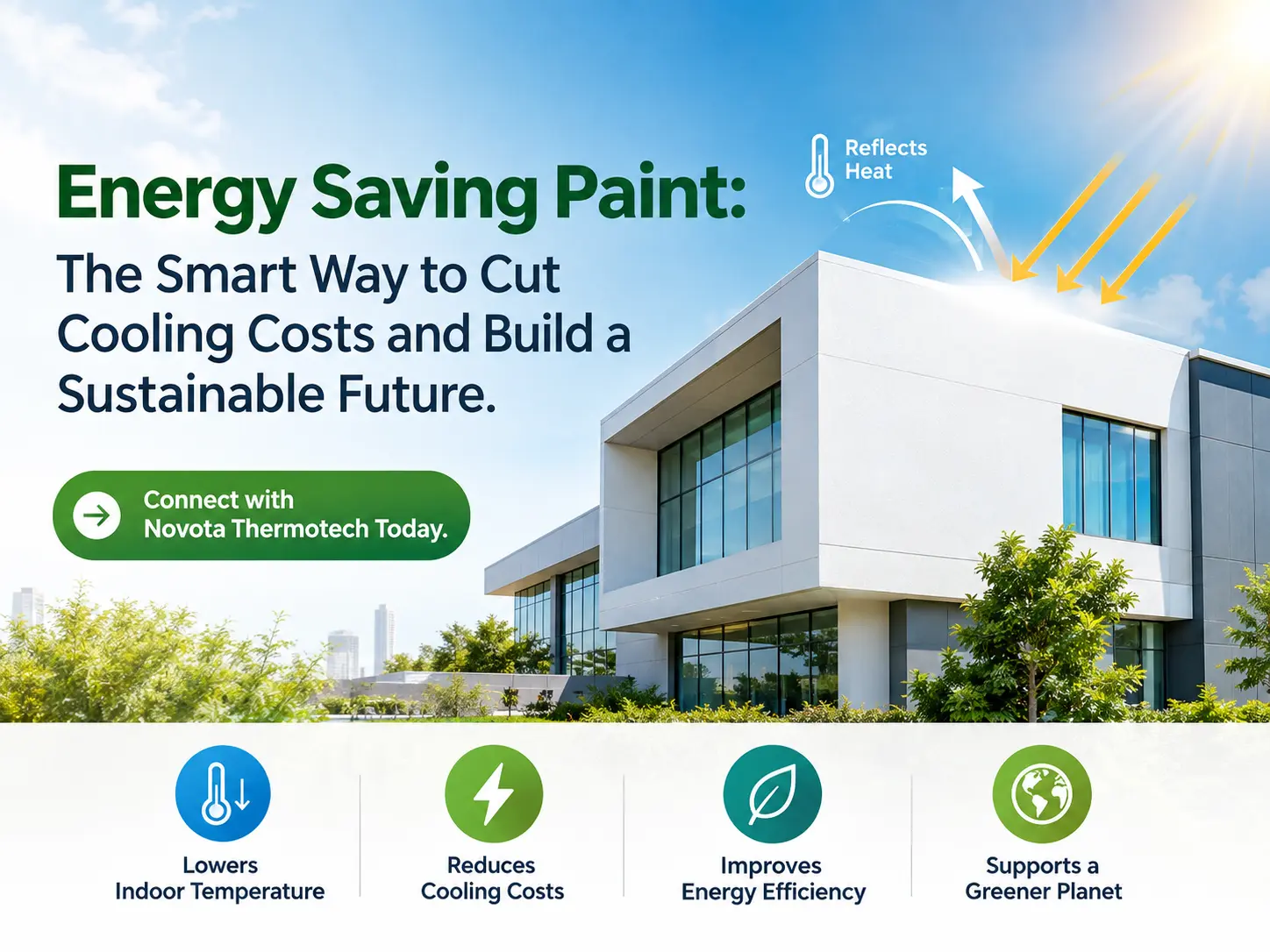
Heat-reflective paint avoids the absorption of heat from building materials and effectively contributes to energy savings. This cool-roof paint can be applied to the roofs of buildings, warehouses, malls, and other commercial spaces.
What is heat-reflective paint?
Heat-reflective paint typically contains nano-ceramic to reflect heat.
This heat-resistant and high-temperature paint redirects the solar radiation away from the surface it covers.
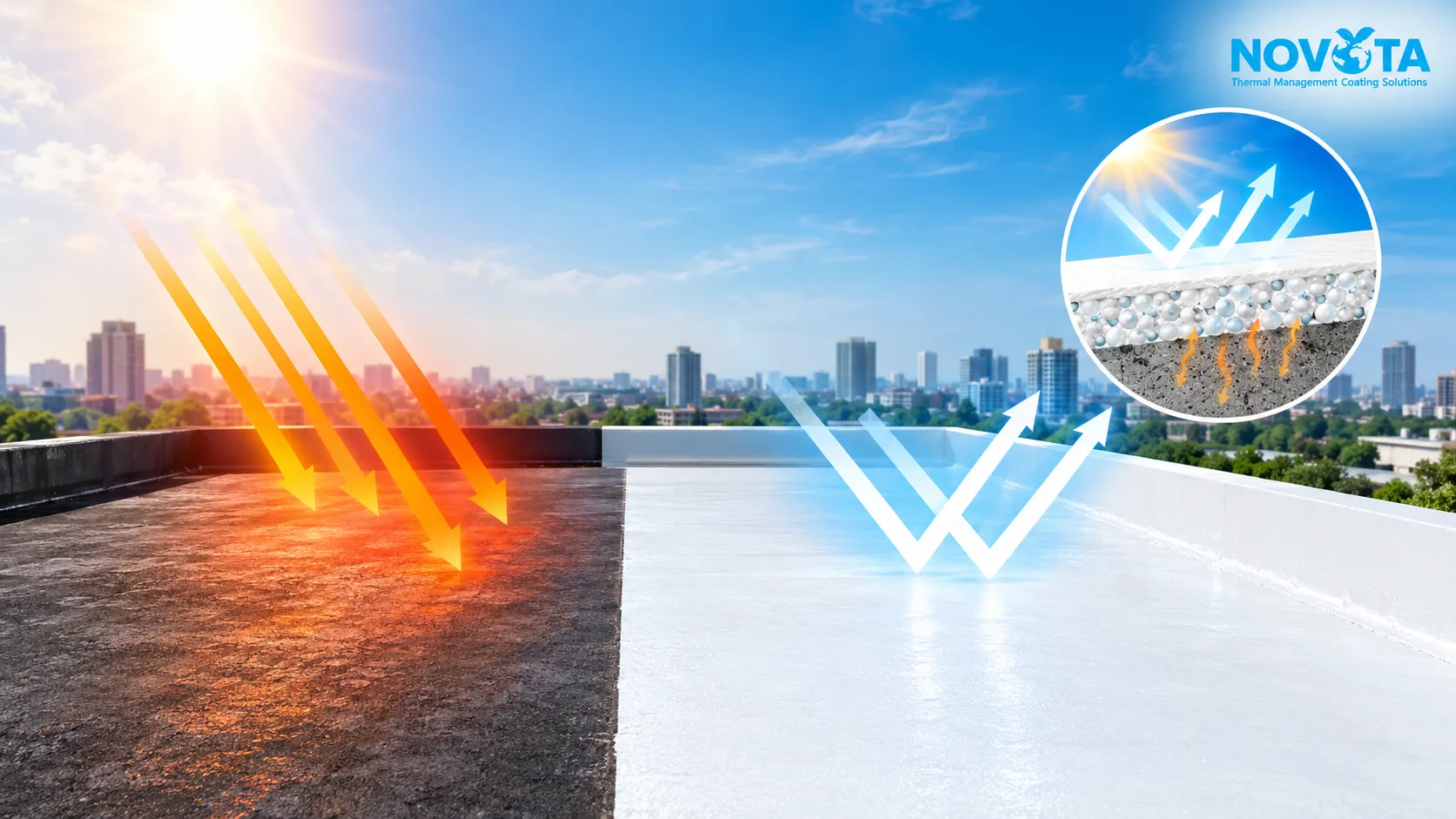
When sunlight hits a surface, it can either be absorbed, transmitted, or reflected. Solar reflective paint minimizes absorption, thereby reducing heat buildup in the material beneath it.
Think of this like an umbrella on a sunny day. Just like it shields you from intense sun rays, heat-reflective paint shields your home from the sun.
Novota Thermotech manufactures Sunsheetal, a heat-reflective, high-albedo paint. Albedo measures a surface’s reflectivity. High albedo means the coatings reflect a significant portion of solar radiation, contributing to energy saving.
Fact: Heat-reflective paint can also enhance energy efficiency in vehicles.
How does Sunsheetal – heat reflective paint improve energy efficiency in buildings?
- Reflectivity: By reflecting more sunlight, these solar reflective coatings reduce heat absorption and keep surfaces cooler.
- Reduced heat absorption: Minimizing heat absorption means the coatings can reduce the need for air conditioning in buildings, leading to lower energy consumption and utility bills. One study revealed that heat-reflective coatings can reduce cooling loads by over 90%.
- Mitigate urban heat island effect: These cool-roof coatings can reduce ambient temperature and mitigate the urban heat island effect in urban areas.
Rajendra Chaudhari, Founder of Novota, says, “The reflective coating will make the environment livable in the future when temperatures will be unbearable due to global warming.”
Interesting to learn about the benefits of heat-reflective paint beyond its energy efficiency improvements.
Read More: Top 7 benefits of using heat reflective paint
For a deeper dive into this topic, check out the video linked below!
Conclusion
Looking at a future where energy resources are becoming increasingly limited, heat-reflective paint is a promising solution. We can create energy-efficient urban spaces with the use of this innovative heat-reflective technology.
Novota Thermotech, a specialty paint and coating manufacturer in India, manufactures innovative heat-reflective paint for effective thermal management.
We are India’s only manufacturer of heat-reflective paint, creating Sunsheetal, a solar—reflective paint with the highest solar reflective index in the country at 108.
With Sunsheetal by Novota, you can enjoy energy-efficient and comfortable living. Contact us today for a free quote on the price of our solar reflective paint.
- How can heat-reflective paint improve energy efficiency in buildings?
- A Guide for Choosing the Right Industrial Coating for Heat Management and Performance
- Heat dissipation coating to effectively manage thermal energy for a global leader in the wire and cable industry
- The Future of Industrial Coatings: Trends and Innovations to Watch
- The Economic Benefits of Investing in High-Performance Industrial Coatings
- Top 7 Benefits of Using Heat Reflective Paint
- Thermal Emissivity Paint
- How to keep terrace cool
- Energy Saving Paint
- Heat Reflective Paint
FAQs
What is heat-reflective coating?
Do walls reflect heat?
Typically, walls made of cement, brick, or concrete do not effectively reflect heat. However, when coated with a heat-reflective coating, they can actively reflect heat away.
What is the best heat reflecting material?
The best heat-reflecting materials often depend on the specific application. However, for roofs in buildings, warehouses, industrial spaces, and even vehicles and petrochemical tanks, the best heat-reflecting material is the one with the highest solar reflective index.
What is the best paint to reflect heat?
Sunsheetal by Novota Thermotech is the best paint to reflect heat, with the highest solar reflective index in India at 108.
Understanding the Science of Heat Transfer in Buildings
To understand how heat-reflective paint improves building energy efficiency, it is important to understand the three fundamental mechanisms through which heat travels: conduction, convection and radiation. These mechanisms continuously influence the temperature of building surfaces and indoor environments. 1. Heat Transfer Through Radiation Solar radiation is one of the primary sources of heat gain in buildings. When sunlight reaches a roof or exterior wall, a portion of its energy is absorbed by the surface. The absorbed energy increases the surface temperature and can subsequently contribute to heat transfer towards the building interior. Conventional roofing materials, particularly dark-coloured surfaces, can absorb a substantial proportion of incoming solar radiation. This increases roof temperature and creates additional thermal loads for the building. Heat-reflective coatings such as SunSheetal are designed to minimize this initial heat absorption by reflecting a greater proportion of incoming solar radiation. This helps maintain lower surface temperatures under suitable environmental conditions. 2. Heat Transfer Through Conduction Conduction is the transfer of heat through solid materials. Once a roof or wall becomes hot due to solar exposure, heat can travel through the building material towards the interior. The rate of conductive heat transfer depends on the thermal conductivity, thickness and temperature difference across the material. By reducing the temperature of the exposed surface, solar reflective coatings can reduce the temperature gradient driving heat transfer through the building structure. This can lower the heat entering indoor spaces, although the actual result also depends on insulation, construction materials and building design. 3. Heat Transfer Through Convection Convection occurs when heat is transferred between a surface and the surrounding air. A roof exposed to direct sunlight becomes hotter than the surrounding atmosphere. It subsequently transfers some of its heat to the surrounding air through convection. Solar reflective paint helps reduce the temperature of the exposed surface, potentially lowering the amount of heat transferred to the surrounding air. Understanding these three mechanisms explains why reducing solar heat absorption at the building envelope can contribute to better thermal management and lower cooling requirements.Solar Reflectance and Thermal Emittance: Two Important Performance Parameters
The effectiveness of heat-reflective paint is not determined simply by its colour or appearance. Two important scientific parameters determine how a coating manages solar energy: solar reflectance and thermal emittance. Solar Reflectance Solar reflectance measures the ability of a surface to reflect incoming solar radiation. Its value generally ranges between 0 and 1, or can be expressed as a percentage. For example, a surface with 0.80 solar reflectance reflects approximately 80% of the incident solar energy under the specified measurement conditions. Higher solar reflectance generally means lower solar energy absorption, helping the surface remain cooler under sunlight. Advanced solar reflective coatings use carefully selected pigments and coating formulations to improve solar reflectance across relevant wavelengths. Thermal Emittance Thermal emittance measures the ability of a surface to emit absorbed thermal energy as infrared radiation. A surface with high thermal emittance can release absorbed heat more effectively through thermal radiation. This property is particularly important because even highly reflective surfaces absorb some solar energy. The ability to release absorbed heat contributes to maintaining a lower equilibrium surface temperature. The combination of high solar reflectance and high thermal emittance is an important characteristic of effective cool-roof coatings.What Is Solar Reflectance Index (SRI), and Why Does It Matter?
The Solar Reflectance Index (SRI) is a calculated measurement used to compare the temperature characteristics of surfaces exposed to sunlight. It considers two important properties:- Solar Reflectance: The ability of a surface to reflect incoming solar energy.
- Thermal Emittance: The ability of a surface to release absorbed thermal energy.
Why Roofs Are Critical for Building Energy Efficiency
Roofs are among the most exposed parts of buildings. Unlike many exterior walls, roofs often receive direct sunlight for several hours throughout the day. This makes roof temperature management particularly important in tropical and subtropical climates. In cities such as Mumbai, Thane, Pune and Ahmedabad, buildings experience considerable solar exposure during warmer months. Industrial sheds, warehouses and commercial buildings with large roof areas can experience substantial heat accumulation. Several factors contribute to this problem:- Direct Solar Exposure: Large roof surfaces receive considerable amounts of solar radiation throughout the day.
- Dark Roofing Materials: Conventional dark surfaces can absorb more solar energy and reach higher temperatures.
- Insufficient Thermal Insulation: Poorly insulated roofs allow more heat to enter indoor spaces.
- Large Building Volumes: Warehouses and industrial facilities often have extensive roof areas that influence internal thermal conditions.
- Continuous Operations: Facilities operating throughout the day may require continuous cooling to maintain comfortable working conditions.
How Heat-Reflective Paint Reduces HVAC Energy Consumption
Heating, ventilation and air-conditioning systems account for a significant proportion of energy consumption in many commercial and residential buildings. How can heat-reflective paint improve energy efficiency During hot weather, air-conditioning systems must continuously remove heat entering the building to maintain the desired indoor temperature. When roofs and exterior walls absorb excessive solar energy, the cooling load increases. This creates additional demand on HVAC equipment. How can heat-reflective paint improve energy efficiency Heat-reflective paint addresses this challenge by reducing the amount of solar energy absorbed by exposed surfaces. The process can be understood through the following sequence:- Sunlight reaches the exposed roof or exterior wall.
- The reflective coating redirects a greater proportion of incoming solar radiation away from the surface.
- Reduced solar absorption helps limit the temperature rise of the coated surface.
- A lower roof surface temperature can reduce heat transfer towards the building interior.
- The indoor cooling system may require less energy to maintain the desired temperature.
Heat-Reflective Paint for Industrial Sheds and Warehouses
Industrial buildings and warehouses present specific thermal management challenges. Many industrial facilities have large metal roofing systems that are directly exposed to sunlight. Metal roofs can heat up rapidly, increasing the temperature of the surrounding air and contributing to indoor heat gain. This creates uncomfortable working conditions, particularly in manufacturing facilities where employees work near machinery and production equipment. How can heat-reflective paint improve energy efficiency Heat-reflective coatings can provide several practical advantages in these environments. Improved Indoor Thermal Conditions By reducing solar heat absorption through the roof, reflective coatings can help moderate indoor temperature conditions. This can improve workplace comfort and potentially reduce the cooling requirements of the facility. Lower Cooling Requirements Warehouses and industrial sheds with large roof areas may experience considerable cooling loads. Reducing the amount of solar heat entering the building can help air-conditioning systems operate under less demanding conditions. How can heat-reflective paint improve energy efficiency Improved Working Environment Excessive indoor temperatures can affect employee comfort and productivity. A suitable roof coating can contribute to a more comfortable indoor environment by reducing the contribution of solar heat gain. Thermal Management for Storage Facilities Temperature-sensitive storage areas may benefit from improved building envelope performance. How can heat-reflective paint improve energy efficiency However, reflective roof coatings should not be considered a replacement for dedicated temperature-control systems where specific storage temperatures must be maintained. How can heat-reflective paint improve energy efficiencyCan Heat-Reflective Paint Help Reduce the Urban Heat Island Effect?
The urban heat island effect occurs when cities experience higher temperatures than surrounding rural areas. This phenomenon is influenced by several factors, including:- Large areas of concrete and asphalt.
- Dark-coloured roofs and building surfaces.
- Limited vegetation and green spaces.
- Heat released by vehicles, air-conditioning systems and industrial activities.
- High-density construction that influences local airflow.
Important Factors to Consider Before Applying Solar Reflective Paint
Selecting the right heat-reflective coating requires more than simply choosing a product with a high reflectivity value. How can heat-reflective paint improve energy efficiency Several technical considerations determine the effectiveness and durability of the coating. 1. Surface Material The substrate plays an important role in coating selection. How can heat-reflective paint improve energy efficiency Concrete roofs, metal sheets, cement-based surfaces and other building materials have different surface characteristics. How can heat-reflective paint improve energy efficiency The coating must be compatible with the substrate and its existing condition. How can heat-reflective paint improve energy efficiency 2. Surface Preparation Proper surface preparation is essential for coating performance. Dust, oil, loose particles, existing coating deterioration and moisture can affect adhesion. The surface should be prepared according to the manufacturer’s technical recommendations. 3. Application Thickness The specified dry film thickness and recommended application rate must be maintained. Insufficient coating thickness or uneven application can affect the intended performance. 4. Weather Resistance Exterior coatings must withstand prolonged exposure to sunlight, rain, humidity and temperature fluctuations. How can heat-reflective paint improve energy efficiency UV stability and resistance to environmental degradation are important considerations. 5. Maintenance Requirements Dust accumulation and environmental contamination can influence the reflective performance of exterior surfaces. Periodic inspection and cleaning, where recommended, help maintain the coating’s intended performance. 6. Existing Insulation Reflective coatings and conventional thermal insulation serve different purposes. Reflective coatings primarily reduce solar heat absorption, while insulation materials restrict heat transfer through the building envelope. Depending on the building requirements, combining these technologies may provide a more comprehensive thermal management solution. How can heat-reflective paint improve energy efficiencySunSheetal: Novota Thermotech’s Approach to Solar Heat Management
Novota Thermotech Pvt. Ltd. develops specialty functional coatings designed to address different thermal management requirements across industrial and building applications. SunSheetal is Novota’s heat-reflective coating developed for applications where reducing solar heat absorption is important. Its high-albedo characteristics are intended to reflect a significant proportion of incoming solar radiation, helping reduce surface temperature under suitable exposure conditions. Unlike conventional decorative paints, the objective of SunSheetal is functional thermal performance. How can heat-reflective paint improve energy efficiency Its application is relevant to suitable building surfaces, including:- Residential building terraces and roofs.
- Commercial building rooftops.
- Industrial sheds and factory roofs.
- Warehouses and logistics facilities.
- Commercial complexes and institutional buildings.
- Other suitable exterior surfaces exposed to direct sunlight.
Heat-Reflective Coatings and Sustainable Building Development
Energy efficiency is becoming an increasingly important consideration in modern building design. With growing urbanization, increasing cooling requirements and rising electricity consumption, buildings need practical solutions to manage heat more effectively. Reflective roofing technologies can contribute to sustainable building practices by reducing unwanted solar heat gain. How can heat-reflective paint improve energy efficiency Their potential environmental benefits include:- Lower cooling energy requirements under suitable conditions.
- Reduced electricity consumption associated with air conditioning.
- Potential reduction in indirect carbon emissions from electricity use.
- Improved thermal comfort in residential and commercial spaces.
- Support for energy-efficient building design.
- Contribution towards cool-roof and urban heat island mitigation initiatives.